

You do not need to own a factory to build a clothing brand. A private label clothing business lets you develop products while a third-party manufacturer handles production under your brand name, labels, and packaging.
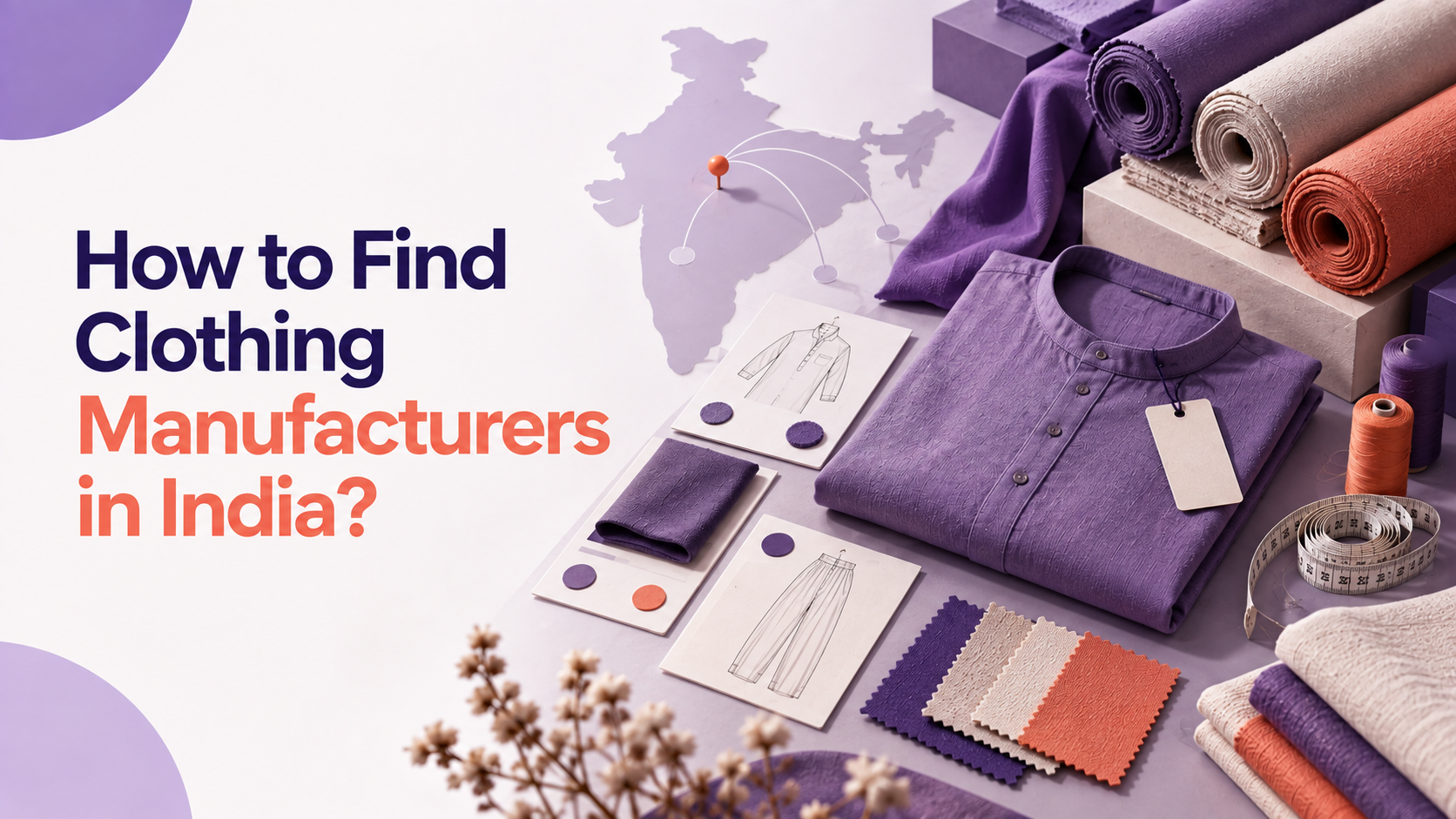
India has established textile and apparel clusters, including knitting hubs such as Tiruppur, Ludhiana, and Delhi and apparel manufacturing centres such as Delhi, Bengaluru, Mumbai, Kolkata, Vapi, and Visakhapatnam.
Private label manufacturing is not simply finding a factory and adding your logo. Product specifications, MOQ, sampling, quality control, pricing, branding, and compliance all affect the business.
Here is how to start one in India.
Key Takeaways
- A private label clothing business allows you to build a clothing brand without owning a manufacturing facility.
- Choose a specific clothing niche and understand target customer’s needs, preferences, and price expectations.
- Create detailed product specifications or tech packs covering fabric, measurements, colours, construction, trims, and finishing.
- Shortlist manufacturers based on their product expertise, production capabilities, MOQ, quality, and reliability, rather than price alone.
- Always verify suppliers and understand whether you are dealing directly with a factory or a sourcing intermediary.
What Is a Private Label Clothing Business?
A private label business sells garments produced by a third-party manufacturer under its brand. You can work with a supplier to develop products around your requirements, including fabric, colour, measurements, fit, trims, labels, packaging, and finishing.
Some manufacturers also provide product development, fabric sourcing, sampling, and packaging support.
This differs from simply buying wholesale clothing and reselling it. Private label gives greater control over the final product and brand. Before approaching suppliers, clarify exactly what each manufacturer includes in its private label service.
Choose a Specific Clothing Niche
Start by deciding who your brand serves. You could focus on women’s western wear, ethnic fashion, streetwear, activewear, loungewear, kidswear, or plus-size clothing.
A focused range makes inventory and marketing easier to manage. It also gives customers a clearer reason to choose your brand.
Research competitor pricing, fabrics, sizing, assortment, and reviews. Repeated complaints can reveal gaps your brand could address.
Your goal is not to copy another business. It is to identify a specific customer and create a product proposition that is easy to understand.
Plan Your First Collection
Once you know your niche, select the products for your first launch. You do not need dozens of styles. A smaller collection can reduce inventory risk. For every product, prepare specifications covering:
- Fabric composition and GSM
- Measurements and size chart
- Colours
- Construction details
- Stitching and finishing
- Prints or embroidery
- Trims
- Labels and packaging
A tech pack can include technical drawings, measurements, materials, artwork, and construction notes for accurate production.
Find Private Label Clothing Manufacturers in India
Your manufacturer affects quality, pricing, production consistency, and delivery, so supplier selection deserves careful research.
Search B2B marketplaces, textile networks, trade exhibitions, referrals, industry associations, and manufacturing clusters. Search by product and location rather than using only broad terms such as “clothing manufacturer.”
Tiruppur is an important knitwear centre, while Delhi-NCR and Bengaluru are among India’s recognised apparel manufacturing locations. Other clusters support different textile and garment categories.
Build a shortlist of several suitable manufacturers instead of placing your first order with the first supplier you find.
Insights: About 94% of the time, users form their opinion about a website based on its design, and an average user takes only 0.05 seconds to decide how they feel about a website after landing on it.
Verify the Supplier
One of the most important questions is whether you are dealing directly with a factory or with a trader or sourcing intermediary. Ask:
- Do you own the manufacturing facility?
- Which processes are performed in-house?
- What do you outsource?
- What garments do you produce regularly?
- What is your production capacity?
- Can you arrange a factory visit or live video walkthrough?
A sourcing intermediary can coordinate fabric, sampling, production, or logistics. The important point is knowing who manufactures your products and controls quality.
Understand MOQ
MOQ, or Minimum Order Quantity, is one of the biggest considerations for new brands.
There is no universal MOQ for private label clothing in India. Requirements vary according to the product, fabric, colour, customisation, and manufacturing setup. Current supplier data and industry guides show that some manufacturers accept very small orders, while others require hundreds of pieces per style or colour.
Ask whether MOQ is calculated per style, colour, fabric, or total order.
Do not choose a supplier simply because it advertises the lowest MOQ. Smaller batches can have higher per-unit costs because fixed expenses are spread over fewer pieces.
Develop and Approve Samples
Do not move directly from an idea to bulk production. Request a sample and check the actual garment for fit, measurements, fabric feel, shrinkage, colour, stitching, prints, embroidery, trims, and finishing.
Your first sample may reveal problems not visible in sketches. Record every revision and ensure the final manufacturer works from the approved specifications.
Use the approved sample as your bulk-production reference.
Calculate the Complete Cost
The manufacturing quote is only one part of your cost. Depending on your arrangement, account for manufacturing, sampling, custom labels, hangtags, packaging, printing or embroidery, shipping, warehousing, payment charges, marketing, returns, and applicable taxes.
Ask for an itemised quotation so you can identify additional costs before placing the order.
For Indian sales, GST treatment depends on classification and transaction value. CBIC states that readymade garments up to ₹1,000 per piece attract 5% GST, while those above ₹1,000 attract 12%. Verify the applicable treatment for your products before finalising retail prices.
Build Your Brand Before Production
Private label manufacturing handles production, but the brand is your responsibility. Develop your brand name, visual identity, packaging, product photography direction, messaging, and positioning before launch.
You should also consider trademark protection. IP India allows individuals, startups, SMEs, companies, and other eligible entities to apply for trademarks, and Class 25 covers clothing, footwear, and headgear.
Check trademark availability before spending heavily on labels, packaging, and marketing.
Get Labels and Packaging Right
Your clothing labels may include brand labels, size labels, care information, hangtags, and packaging.
Labelling is not only a branding decision. Pre-packaged retail products can be subject to declarations under India’s Legal Metrology framework. The Department of Consumer Affairs lists requirements that can include manufacturer or packer details, product description, MRP, consumer-care information, and other applicable declarations.
Requirements depend on the product and how it is manufactured, packed, imported, and sold. Confirm the applicable rules before printing labels at scale.
Set Quality-Control Standards
Define your quality expectations before production starts. Agree on measurement tolerances, fabric specifications, colour standards, stitching quality, defect limits, packaging requirements, and inspection procedures.
Ask how the manufacturer checks fabric, cutting, sewing, finishing, and packing. For larger orders, independent inspection can add another check before dispatch.
Do not assume every garment requires BIS certification. BIS states certification is generally voluntary unless a product is subject to compulsory certification through a Quality Control Order. Check whether any specific requirement applies to your product category.
Insights: A well-designed website can significantly increase engagement, with users spending up to 84% more time on your site, while also driving up to a 132% year-over-year growth in online revenue.
Confirm Production Timelines
Ask for separate timelines for sampling, approvals, bulk production, finishing, and dispatch.
Lead times can change because of fabric availability, dyeing, trims, order volume, approvals, and factory capacity. Current Indian sourcing guidance gives examples ranging from a few weeks for samples to several weeks for production, but these figures are supplier-specific rather than universal.
Keep a buffer between expected production completion and your launch date.
Document the Manufacturing Agreement
Once you select a supplier, put the commercial and technical terms in writing. Document the approved sample, specifications, quantity, price, payment schedule, production timeline, packaging, inspection standards, rejection or rework procedures, and responsibilities for delays or changes.
Also clarify ownership of original artwork, patterns, branding assets, and custom-developed materials where relevant. Written terms matter especially when you invest in original designs or plan future collections.
Common Private Label Mistakes
Choosing a manufacturer purely on price can create quality problems. Ordering too much inventory before testing demand can tie up working capital. Launching without accurate size specifications can increase returns. Treating the first sample as final can allow defects to repeat across the entire batch.
Another common mistake is launching too many products at once. A focused collection gives you better visibility into which styles, sizes, and price points customers actually want.
Is a Private Label Clothing Business Profitable in India?
Private label clothing can be commercially viable, but profitability depends on product-market fit, pricing, unit economics, inventory management, customer acquisition, and repeat purchases.
Manufacturing cost alone does not determine profit. A product with an attractive factory price can become unprofitable after advertising, discounts, shipping, returns, and other operating expenses.
Start with a manageable collection, track feedback, improve products that show demand, and scale when economics support it.
Insights: On average, it takes about 2.6 seconds for a user’s eyes to focus on the most important areas of a web page.
Final Thoughts
A private label clothing business in India lets entrepreneurs build a fashion brand without owning a manufacturing facility. Treat manufacturing as part of the business, not a one-time sourcing exercise.
Start with a clear niche and product specification. Shortlist manufacturers based on capability, MOQ, quality, and reliability. Approve samples before bulk production, calculate your complete cost, build your brand, and document every important manufacturing term.
Once your products consistently meet quality and margin targets, customer feedback and sales data can guide your next collection and help you build a more scalable fashion business.