

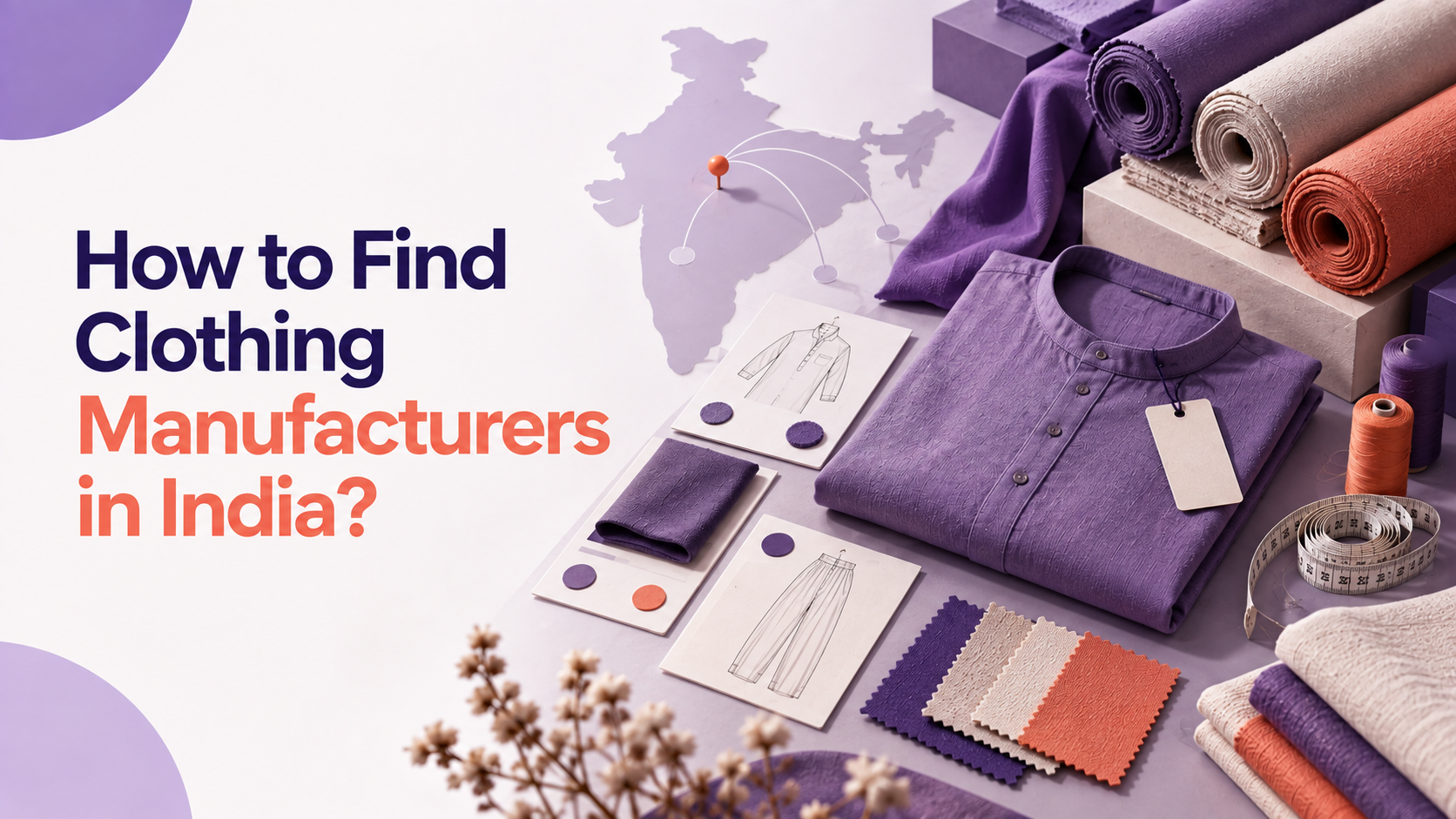
Finding the right clothing manufacturer can determine whether your fashion brand achieves consistent quality or struggles with delays, defects, and rising costs. India has a large and diverse apparel manufacturing ecosystem, but every factory has different capabilities, minimum order quantities, production strengths, and quality standards.
The challenge is not simply finding clothing manufacturers in India. It is finding a manufacturer that fits your product, budget, order volume, quality expectations, and growth plans.
India has established textile and apparel clusters across several regions. Invest India identifies Delhi, Ludhiana, and Tiruppur as major knitting clusters, while Delhi, Bengaluru, Mumbai, Kolkata, Vapi, and Visakhapatnam are identified as apparel manufacturing clusters.
Here is how to find, evaluate, and select the right manufacturing partner for your clothing brand.
- Define your product, fabric, quantity, quality standards, and budget before contacting manufacturers.
- Choose manufacturing clusters based on your product category and production requirements.
- Use B2B platforms, trade shows, industry networks, referrals, and sourcing agencies to find suppliers.
- Verify whether a supplier operates its own factory or works as a trader or sourcing intermediary.
- Compare MOQs carefully because requirements vary by product, fabric, colour, and production process.
- Always request samples before committing to bulk production.
- Compare the complete landed cost instead of choosing the lowest quotation.
Define What You Want to Manufacture
Before searching for manufacturers, create a clear product brief. Manufacturers cannot provide accurate quotations when you only describe your idea as “premium clothing” or “cotton dresses.” Define the following:
- Product category, such as T-shirts, dresses, shirts, jeans, or activewear
- Fabric type and composition
- Fabric weight or GSM
- Colours and size range
- Measurements and fit
- Printing, embroidery, washing, or other finishes
- Labels, tags, and packaging
- Expected order quantity
- Target production cost
- Required delivery date
A technical pack can make this process much easier. Include technical drawings, measurements, fabric details, construction instructions, trims, artwork, and packaging requirements.
A clear brief also makes supplier comparison easier because every manufacturer receives the same information.
Choose the Right Manufacturing Cluster
India does not have one single clothing manufacturing hub. Different regions have developed expertise in different textile and apparel categories.
Tiruppur is particularly important for knitted garments and cotton knitwear. Ludhiana has a strong knitwear and hosiery ecosystem. Delhi and the National Capital Region have extensive garment manufacturing capabilities, while Bengaluru is another established apparel manufacturing centre. Surat is especially important for synthetic and man-made textile production.
Your product should influence where you search.
For example, a brand developing cotton T-shirts may explore Tiruppur, while a brand looking for certain woven fabrics may investigate Surat or Ahmedabad alongside garmenting hubs.
However, location alone should never determine your choice. A manufacturer in the right cluster can still be unsuitable if its machinery, MOQ, quality systems, or production capacity does not match your requirements.
Search Through Multiple Channels
Once you know what you need, build a list of potential apparel suppliers in India from several sources.
Online B2B marketplaces can provide a large number of initial leads. Search using specific terms rather than only “clothing manufacturer.” Try searches such as “Tiruppur cotton T-shirt manufacturer,” “private label womenswear manufacturer India,” or “small batch garment manufacturer India.”
Trade shows and textile exhibitions can also help you meet manufacturers directly. Industry associations, referrals from other brand owners, sourcing professionals, and textile networks can provide additional leads.
Do not depend on a single platform. A company appearing prominently in search results does not automatically mean it operates its own manufacturing facility.
Shortlist Manufacturers Carefully
After collecting potential suppliers, narrow your list to manufacturers that match your requirements.
Review their product categories, factory capabilities, previous work, production capacity, certifications, location, communication quality, and MOQ.
One important question is whether the company is actually a manufacturer, a trading company, or a sourcing intermediary. These models can all work, but they offer different levels of control and pricing.
Ask directly:
- Do you own the production facility?
- Which production processes happen in-house?
- Which processes do you outsource?
- What products do you manufacture regularly?
- What is your current production capacity?
- Can you provide factory photographs or arrange a factory visit?
Current Indian sourcing guidance also recommends checking which stages a supplier actually performs rather than relying solely on its website description.
Insights: About 94% of the time, users form their opinion about a website based on its design, and an average user takes only 0.05 seconds to decide how they feel about a website after landing on it.
Understand MOQ Before Placing an Order
MOQ means Minimum Order Quantity. It represents the smallest quantity a manufacturer is willing to produce under agreed conditions.
MOQ can vary considerably depending on the garment, fabric, colour, manufacturing process, and whether the fabric is readily available or needs custom development.
For example, stock-fabric production can have different requirements from custom-dyed fabric. A manufacturer may also calculate minimums by style, colour, or other production variables.
Do not choose a supplier simply because it advertises an extremely low MOQ. A low MOQ may come with higher unit costs, limited customisation, or a different production model.
Ask each manufacturer to explain exactly how its MOQ works before comparing quotations.
Request Samples Before Bulk Production
Never treat a manufacturer’s catalogue or previous work as proof that it can produce your specific product correctly.
Sampling allows you to evaluate the actual garment before committing to bulk production.
Check the sample for:
- Fabric composition and feel
- GSM and shrinkage
- Measurements and fit
- Stitch quality
- Seams and finishing
- Colour accuracy
- Printing or embroidery
- Buttons, zippers, and other trims
- Labels and packaging
For complex garments, you may need several development stages. A pre-production sample using the final approved fabric and trims can provide an important reference for bulk manufacturing.
Keep written records of sample revisions. Do not rely on verbal instructions when measurements or construction details change.
Compare the Complete Manufacturing Cost
The cheapest quotation is not necessarily the lowest production cost.
Ask manufacturers to clarify what their quotation includes. Depending on the agreement, costs can involve fabric, trims, cutting, stitching, printing, embroidery, washing, finishing, labels, packaging, testing, freight, and other services.
Also establish whether the quotation is ex-factory, FOB, CIF, or based on another agreed Incoterm. These terms affect how you calculate your final landed cost.
A useful approach is to calculate: Product cost + packaging + freight + duties/taxes + inspection + other applicable charges = landed cost
It gives you a more realistic view of your potential profit margin.
Verify the Manufacturer Before Paying
Supplier verification is one of the most important steps when sourcing garment manufacturers in India.
Check the company’s business details, GST information, factory address, certifications, references, and production history where applicable.
If possible, arrange a factory visit or live video walkthrough. Look at the cutting, stitching, finishing, storage, quality-control, and packing areas.
Pay attention to whether the facility appears capable of producing your order at the promised scale.
You can also request references from previous customers, particularly brands producing similar garments.
A professional manufacturer should be able to answer detailed questions about production instead of providing only a generic product catalogue.
Evaluate Quality-Control Procedures
Quality control should begin before bulk production, not after finished garments reach your warehouse.
Ask the manufacturer how it checks fabric, measurements, stitching, colour, trims, finishing, and packing.
The Textiles Committee under India’s Ministry of Textiles conducts technical studies, establishes or recognises textile specifications, and provides quality-control and inspection functions.
For your own production, agree on measurable quality requirements before manufacturing begins. Define acceptable measurement tolerances, colour standards, fabric specifications, workmanship expectations, and defect-handling procedures.
For larger orders, you can also consider independent pre-shipment inspection.
Confirm Production Capacity and Lead Time
A manufacturer may produce excellent samples but struggle with your bulk order.
Ask about current capacity, production schedules, fabric availability, sampling time, bulk production time, and shipping preparation.
Do not accept a generic promise such as “delivery in 30 days.” Ask when the timeline starts and what it includes.
Lead times can change depending on fabric sourcing, custom dyeing, embroidery, printing, order volume, approvals, and seasonal capacity. Current Indian supplier guides also emphasise that sampling and production timelines vary by product and manufacturing setup.
Build some buffer into your launch calendar instead of planning around the earliest promised date.
Discuss Payment Terms Clearly
Before confirming production, document the payment structure. Clarify:
- Sample charges
- Deposit requirements
- Balance payment timing
- Payment method
- Currency
- Cancellation terms
- Costs arising from design changes
- Conditions for rework or defective goods
Put agreed specifications and commercial terms into a written purchase order or manufacturing agreement.
It reduces the risk of disagreements later, particularly when several revisions occur during product development.
Insights: A well-designed website can significantly increase engagement, with users spending up to 84% more time on your site, while also driving up to a 132% year-over-year growth in online revenue.
What Factors Influence the Online Store Cost in Noida?
The online store cost in Noida is heavily influenced by the technology stack (CMS vs. Custom), the level of design customization, and third-party API integrations. A store built on a free template will always be cheaper than one with a custom-designed user interface.
How Does the Platform Choice Affect the Budget?
The platform you choose is the biggest cost driver; open-source platforms like WooCommerce are cheaper to set up, while custom frameworks like Magento or MERN stack involve higher eCommerce website development cost in Noida.
- WooCommerce (WordPress): Most affordable. Good for small to medium stores. Developers in Noida charge less for this.
- Shopify: Moderate setup cost, but you pay monthly fees. Customizing Shopify themes can get expensive.
- Magento: Expensive. Suitable for large enterprises. Requires specialized developers who charge high hourly rates.
- Custom (React/Node.js): Most expensive. Built from scratch for specific business needs.
Do Design and Customization Impact the Price?
Yes, custom UI/UX design can raise the eCommerce website price in Noida by 30% to 50%. While ready-made themes cost very little (₹4,000 – ₹10,000), a unique design created from scratch by a professional designer ensures your brand stands out.
If you use a pre-made template, the developer just changes the logo and colors. This is cheap. However, if you want a unique layout, custom animations, and a specific user journey, a designer must draw every page before a developer codes it. This dual effort of design and development increases the overall budget significantly.
How Much Do Payment Gateways and APIs Add to the Cost?
Integrating standard payment gateways like Razorpay or Paytm is usually included, but advanced API integrations for shipping, ERP, or CRM can add ₹20,000 to ₹1,00,000 to the online store cost in Noida.
A basic store needs a payment gateway to accept money. This is standard. But if you want your website to automatically send orders to your warehouse software (ERP), or calculate live shipping rates using a courier’s system (like Shiprocket), developers need to write custom code to connect these systems (APIs). This takes time and technical skill, increasing the final invoice.
Freelancer vs. Agency: Which is Better for Your Budget?
Hiring a freelancer can reduce the eCommerce website development cost in Noida by nearly 50%, but agencies offer greater reliability, ongoing support, and a diverse team of experts. Your choice depends on your budget and risk tolerance.
Freelancer vs. Agency Pricing
| Item | Description | Estimated Cost (INR) |
|---|---|---|
| Premium Plugins | Tools for SEO or Forms (Yearly) | ₹3,000 – ₹10,000 |
| Stock Photos | High-quality images (Per 5 pics) | ₹2,500 – ₹5,000 |
| Training | Learning to use the website | ₹2,000 – ₹5,000 |
Is Hiring a Freelancer Cheaper for eCommerce?
Yes, hiring a freelancer is much cheaper, with costs often starting as low as ₹30,000. Freelancers in Noida usually work from home and have low overheads, allowing them to pass savings on to you.
This option is great if you are just testing a business idea or have a very tight budget.
However, a single freelancer handles everything, design, coding, and testing.
If they are good at coding, they might be bad at design. Also, if they get sick or vanish, your project stops. This risk is why the online store cost in Noida is lower with freelancers.
Why is Agency Pricing Higher for Online Stores?
Agencies charge more, typically starting from ₹1,00,000, because they provide a structured process, legal contracts, and a team comprising designers, developers, and project managers.
When you pay an agency, you are paying for peace of mind. They have quality assurance (QA) testers who make sure your shopping cart doesn’t break. They have project managers who keep you updated. If one developer leaves, the agency replaces them immediately.
For serious businesses, the higher eCommerce website development cost in Noida charged by agencies is an investment in stability and quality.
Insights: On average, it takes about 2.6 seconds for a user’s eyes to focus on the most important areas of a web page.
Conclusion
The eCommerce website development cost in Noida is highly competitive, offering excellent value for money compared to other tech hubs. Whether you are a small startup looking for a ₹40,000 basic store or a large enterprise planning a ₹10,00,000 custom marketplace, Noida has the talent pool to deliver.
However, it is vital to remember that an eCommerce website is a business asset, not just a digital brochure. It handles money and customer data. Therefore, prioritizing quality, security, and user experience over the lowest possible price is the smart strategy.
By understanding the detailed breakdown of the eCommerce website price in Noida, the recurring costs, and the factors that influence the budget, you can make an informed decision. Investing wisely in your platform now will ensure smooth operations and higher sales in the future.