


More website traffic does not automatically translate into more fashion sales. Your brand might attract thousands of visitors through Instagram, Google, and paid advertising, yet struggle to convert them into paying customers.
The reason could be unclear product information, poor mobile shopping experiences, complicated checkout, or a lack of trust. To increase online sales for a fashion brand in 2027, focus on improving the entire customer journey, from product discovery to repeat purchases.
Instead of increasing advertising spend immediately, identify where potential customers drop off and remove the obstacles preventing them from buying.
For fashion ecommerce businesses, the strongest growth strategy combines conversion rate optimisation (CRO), product page improvements, search visibility, customer retention, and data-driven marketing.
Key Takeaways
Improve your fashion ecommerce website’s conversion rate before increasing advertising spend.
Optimise product pages with high-quality images, accurate size charts, and detailed descriptions.
Create a mobile-first shopping experience with fast-loading pages and easy navigation.
Simplify checkout, offer best payment options, & display delivery costs upfront to reduce cart abandonment.
Strengthen SEO to attract organic traffic from customers searching for relevant fashion products.
Use authentic customer reviews, creator content, and user-generated photos to build purchase confidence.
Increase average order value through relevant product bundles, complementary items, & shipping thresholds.
Proven Strategies to Increase Online Sales for Fashion Brands
Increasing online sales requires more than driving traffic to your ecommerce website. Fashion brands need to optimise every stage of the customer journey, from product discovery and purchase decisions to checkout and repeat buying.
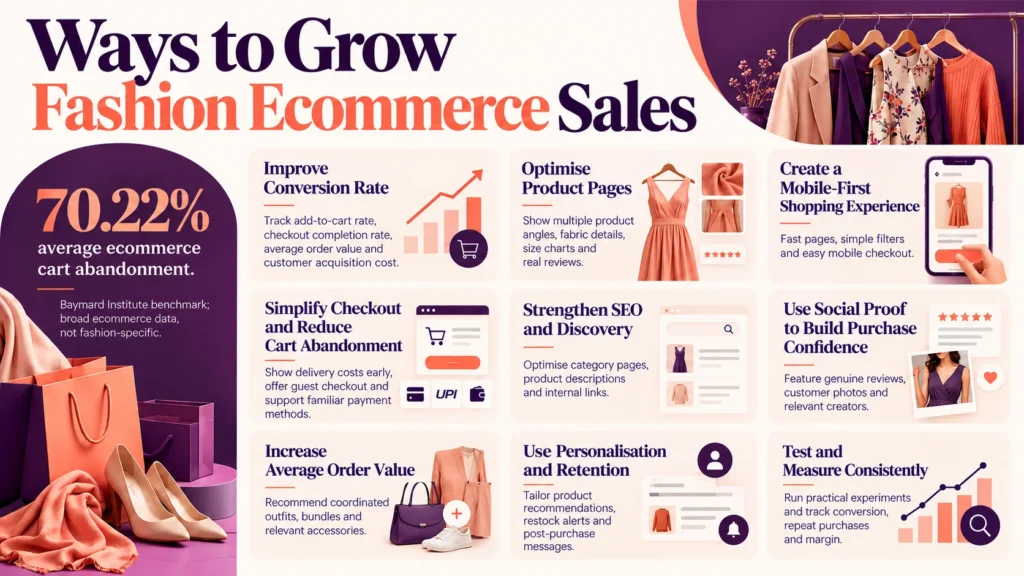
The following strategies focus on improving conversion rates, building customer trust, increasing average order value, and strengthening long-term revenue growth.
Improve Your Fashion Ecommerce Website's Conversion Rate
Before investing more money in traffic acquisition, understand how effectively your website converts existing visitors.
Track your purchase conversion rate, add-to-cart rate, checkout completion rate, average order value (AOV), and customer acquisition cost (CAC). Shopify also recommends monitoring these metrics to understand where shoppers leave the purchasing journey.
For example, if your product pages attract substantial traffic but generate few add-to-carts, investigate product presentation, pricing, sizing information, and customer reviews.
If shoppers add products to their carts but do not purchase, examine delivery costs, payment options, and checkout friction.
Optimise Product Pages to Convert More Visitors
Product pages play a central role in fashion ecommerce because shoppers cannot physically touch the fabric, assess the fit, or try on a garment before buying.
A product page should answer the questions customers would normally ask in a store.
Include high-quality images from multiple angles, close-ups of fabric and stitching, detailed product descriptions, accurate size charts, fabric composition, care instructions, and clear information about the model’s measurements.
For apparel, consider adding videos showing how a garment moves, styling suggestions, and fit guidance. Customer reviews that mention sizing and fabric quality can further reduce purchase uncertainty.
Make the price, available sizes, colour options, delivery information, and add-to-cart button easy to locate.
Shopify’s current product page guidance similarly emphasises imagery, descriptions, reviews, calls to action, and SEO as important elements of product page optimisation.
Create a Mobile-First Shopping Experience
Fashion discovery frequently happens through social media and mobile browsing. A shopper might discover a dress in an Instagram Reel, visit your website, compare sizes, and complete the purchase on the same phone.
If the website is difficult to navigate on mobile, that purchase journey can break down.
Prioritise responsive layouts, readable text, accessible product filters, easy-to-select size options, fast-loading product images, and a checkout that does not require unnecessary typing.
Test the complete shopping experience on different mobile devices. Check whether visitors can quickly find products, change variants, understand delivery charges, and complete payment without errors.
Website performance also matters. Monitor loading behaviour and Core Web Vitals alongside conversion data to identify technical problems that affect usability.
Insights: About 94% of the time, users form their opinion about a website based on its design, and an average user takes only 0.05 seconds to decide how they feel about a website after landing on it.
Simplify Checkout and Reduce Cart Abandonment
A shopper who reaches checkout has already shown purchase intent. Additional friction at this stage can cost your brand a sale.
Baymard Institute’s research places average ecommerce cart abandonment at 70.19% across its tracked global data. This is a broad ecommerce benchmark, not a fashion-specific conversion rate, but it highlights the scale of the checkout challenge.
To reduce avoidable abandonment, offer guest checkout, display shipping charges early, provide a clear order summary, and minimise unnecessary form fields.
Support payment methods suited to your audience. For Indian fashion stores, this may include UPI, cards, net banking, and cash on delivery where commercially appropriate.
Also show estimated delivery dates and explain return and exchange policies before payment.
If customers abandon their carts, use consent-based email or WhatsApp reminders where appropriate. Keep these messages useful and make it easy for customers to return to their saved items.
Strengthen Product Discovery Through SEO
Paid advertising can generate immediate visits, but search engine optimisation helps fashion brands reach customers who are actively looking for products.
Optimise category pages, collection pages, and product descriptions around relevant search intent. For example, a clothing brand might target queries related to linen shirts, women’s workwear, oversized T-shirts, or occasionwear.
Avoid using identical descriptions across multiple products. Explain what makes each item different, including fabric, fit, colour, occasion, and care requirements.
Improve internal links between relevant collections, products, and buying guides. Make sure search engines can crawl important product and category pages.
Google also supports product structured data that can make product pages eligible for enhanced search presentations containing information such as price, availability, ratings, and shipping details, depending on eligibility and implementation.
SEO works best as part of a wider acquisition strategy, alongside social media, email, and paid campaigns.
Use Social Proof to Build Purchase Confidence
Customers often want reassurance before purchasing from an unfamiliar fashion brand.
Reviews, customer photographs, creator content, and user-generated videos can provide useful evidence of how products look and fit outside a studio shoot.
Display relevant reviews on product pages. Encourage genuine post-purchase feedback and ask customers to share photographs where appropriate.
Fashion brands can also collaborate with creators whose audiences match their target customers. A smaller creator with relevant followers may offer a better commercial fit than a large account with a broad, disconnected audience.
Avoid fabricated testimonials, misleading reviews, or unsubstantiated product claims. Trust built through authentic customer experiences is more sustainable than superficial social proof.
Increase Average Order Value Without Overusing Discounts
Increasing revenue does not always require attracting more customers. You can also increase the value of each order by helping shoppers discover complementary products.
Consider coordinated outfit recommendations, carefully selected product bundles, complementary accessories, or free-shipping thresholds based on your margins.
For example, a customer purchasing a shirt could see matching trousers or a relevant accessory. A shopper browsing a coordinated ethnicwear collection could explore complementary pieces.
Keep recommendations relevant rather than filling every page with unrelated products.
Review average order value, gross margin, and conversion rate together. A promotion that increases basket size but significantly reduces profit may not be worthwhile.
Personalise the Shopping Experience
Relevant recommendations can make product discovery easier and encourage customers to explore more of your collection.
Use browsing behaviour, previous purchases, selected preferences, and product relationships to improve recommendations where appropriate and permitted.
For example, returning customers could see complementary products, while shoppers browsing a particular collection could receive relevant suggestions from that category.
Personalisation should remain useful and transparent. Avoid collecting or using customer data without an appropriate legal basis, and respect consent and communication preferences.
Start with simple, measurable changes before investing in complex recommendation systems.
Turn First-Time Buyers Into Repeat Customers
A fashion brand that depends entirely on new customers may face increasing acquisition costs and unstable revenue.
Build retention into your ecommerce strategy through thoughtful post-purchase communication, relevant product recommendations, new collection announcements, and restock notifications.
Segment communication according to customer behaviour instead of sending every promotion to everyone.
For example, customers who purchased casualwear could receive updates about complementary styles, while repeat buyers might appreciate early access to new collections.
Product quality remains essential. Accurate sizing, consistent fabric quality, reliable delivery, and clear exchange policies give customers practical reasons to purchase again.
Measure repeat purchase rate, customer lifetime value, and contribution margin to understand whether retention initiatives are improving business performance.
Measure Results and Test Improvements
Do not assume that every ecommerce best practice will produce the same results for every brand. Use analytics to establish a baseline, identify problems, and prioritise experiments.
Test changes such as alternative product images, clearer size guidance, different product-page layouts, improved delivery messaging, or simplified checkout fields.
Change one major variable at a time when practical, use a sufficiently large sample, and measure the result against a defined objective.
A/B testing can help determine which version performs better, but smaller stores may not receive enough traffic for every test to produce a reliable conclusion. In those cases, combine quantitative analytics with customer feedback and usability testing.
Review performance by device, traffic source, product category, and new versus returning customers. This helps distinguish broad website issues from problems affecting specific products or audiences.
Insights: A well-designed website can significantly increase engagement, with users spending up to 84% more time on your site, while also driving up to a 132% year-over-year growth in online revenue.
Common Mistakes That Limit Fashion Ecommerce Sales
Several recurring problems can prevent a fashion brand from turning traffic into revenue:
Relying entirely on paid ads: Acquisition becomes vulnerable to rising costs when organic discovery and customer retention remain weak.
Using inadequate product information: Missing fit, fabric, and sizing details leave customers uncertain.
Hiding delivery costs: Unexpected charges can cause shoppers to abandon checkout.
Offering blanket discounts: Frequent promotions can weaken margins and train customers to wait for sales.
Ignoring returns and exchanges: Poor policies or unclear instructions damage purchase confidence.
Making changes without measurement: Untracked redesigns and marketing experiments make it difficult to determine what drives results.
Fix the issues that have the greatest measurable effect on your customer journey before expanding your marketing budget.
Insights: On average, it takes about 2.6 seconds for a user’s eyes to focus on the most important areas of a web page.
Conclusion
To increase online sales in 2027, fashion brands need more than additional traffic. They need an ecommerce experience that helps customers discover products, evaluate quality and fit, purchase easily, and return for future collections.
Start by reviewing your conversion funnel. Improve product pages, streamline mobile checkout, strengthen SEO, use authentic customer proof, and develop retention campaigns. Then measure the effect of each improvement on revenue and profitability.
For brands struggling with low conversion rates despite strong traffic, a structured fashion ecommerce CRO strategy can help identify the barriers to purchase and prioritise practical improvements.
Combining conversion optimisation with a well-built ecommerce website creates a stronger foundation for sustainable revenue growth.