

If you are planning to launch a clothing brand online, understanding the fashion ecommerce website cost in India is one of the first steps in setting a realistic budget.
A fashion ecommerce website is more than a digital catalogue. It needs product filters, size and colour variants, high-quality images, secure payments, shipping integration, inventory management, mobile optimization, SEO, and a checkout experience that does not create unnecessary friction.
That is why website quotes can vary dramatically. A basic Shopify store may cost tens of thousands of rupees, while a highly customized fashion ecommerce platform can run into several lakhs. Current Indian market estimates for fashion ecommerce websites range from roughly ₹15,000 to ₹25 lakh+, depending on platform, complexity, integrations, and scale.
So, what should a clothing brand actually budget?
- The fashion ecommerce website cost in India can range from around ₹15,000 to ₹15 lakh+, depending on the platform, design, features, integrations, and business size.
- A professional Shopify fashion store generally costs around ₹80,000-₹2 lakh for development, excluding ongoing platform and third-party expenses.
- A customized WooCommerce store can cost around ₹1 lakh-₹3 lakh or more, depending on plugins, integrations, design, and technical requirements.
- Custom or headless ecommerce development can start around ₹3 lakh and reach ₹15 lakh+ for complex fashion businesses.
How Much Does a Fashion Ecommerce Website Cost in India?
The fashion ecommerce website cost in India typically falls between ₹60,000 and ₹8 lakh for most small to mid-sized brands, while enterprise-grade or highly customized stores can cost considerably more.
A practical budget depends largely on the type of store you want to build.
| Type of Fashion Ecommerce Website | Approx. Development Cost in India | Best For |
|---|---|---|
| Basic template-based store | ₹15,000–₹60,000 | New clothing startups |
| Professional Shopify store | ₹80,000–₹2 lakh | D2C fashion brands |
| Custom WooCommerce store | ₹1 lakh–₹3 lakh | Growing brands |
| Advanced ecommerce store | ₹3 lakh–₹8 lakh | Established fashion businesses |
| Custom/headless ecommerce | ₹5 lakh–₹15 lakh+ | Large or complex brands |
| Enterprise ecommerce | ₹15 lakh+ | Large fashion companies |
These are practical market ranges rather than fixed industry rates. Indian development estimates vary significantly based on catalogue size, design requirements, integrations, and technical complexity.
The important point is that you should not select a development package based only on its starting price.
A ₹60,000 store may be perfectly adequate for a small catalogue. It may become expensive later if you need custom filtering, advanced search, ERP integration, personalization, or a major redesign.
What Determines Fashion Ecommerce Website Cost in India?
The fashion ecommerce website cost in India is influenced by several components. Platform selection is only one of them.
Your product catalogue, design requirements, payment system, shipping workflow, integrations, SEO requirements, and level of customization can all change the final quotation.
1. Ecommerce Platform
Your first major decision is the platform. For most Indian fashion brands, the practical options include Shopify, WooCommerce, and custom ecommerce development.
Shopify generally requires less technical infrastructure management because it is a hosted ecommerce platform. WooCommerce provides greater control but requires WordPress hosting and ongoing technical management.
Current Indian development estimates place professional Shopify implementation around ₹80,000-₹2 lakh, while customized WooCommerce implementations can range from roughly ₹60,000 to ₹1.5 lakh and beyond depending on requirements.
A custom ecommerce platform costs considerably more because developers need to build and maintain more of the underlying system.
2. Number of Products and Variants
A fashion store with 30 products is very different from one with 3,000 products. Consider a clothing brand selling:
- 200 products
- 6 sizes per product
- 5 colour options
- Separate SKUs
- Multiple product images
- Size charts
- Different inventory levels
The development team needs to structure and test all these elements properly. More products do not always mean proportionally higher development costs.
However, a large catalogue increases the importance of search, filtering, bulk product management, inventory synchronization, and performance optimization.
3. Custom UI/UX Design
A template-based fashion store is cheaper than a completely custom website. A basic store might use an existing theme with your logo, colours, typography, product images, and content. A premium fashion brand may want something completely different. It may require:
- Custom homepage design
- Bespoke collection pages
- Advanced product pages
- Custom navigation
- Interactive product displays
- Mobile-specific layouts
- Custom animations
- Conversion-focused checkout
The more pages and interactions designers need to create from scratch, the higher the development cost becomes.
For fashion brands, however, design should not be treated purely as decoration. Your website is part of your brand identity. It also influences how easily customers understand products and move towards checkout.
How Much Does a Shopify Fashion Store Cost in India?
A professionally developed Shopify fashion store in India can typically cost around ₹80,000 to ₹2 lakh, while highly customized implementations can move beyond ₹3 lakh.
One advantage of Shopify is that you do not have to build the entire ecommerce infrastructure yourself. The developer can focus primarily on:
- Store design
- Theme customization
- Product setup
- Navigation
- Collection structure
- Payment integration
- Shipping integration
- Apps
- SEO configuration
- Testing
Shopify’s India pricing is separate from development charges. Its current plans start at ₹1,499 per month when billed annually for Basic, while higher plans cost more.
Therefore, your actual budget should include both development and recurring platform expenses.
Insights: About 94% of the time, users form their opinion about a website based on its design, and an average user takes only 0.05 seconds to decide how they feel about a website after landing on it.
When Is Shopify the Better Choice?
Shopify is particularly practical for a new D2C fashion brand that wants to launch quickly.
For example, imagine a clothing startup with 80 products. It needs a professional design, Razorpay, COD, shipping integration, reviews, Instagram marketing, and basic SEO.
There is little reason to build a custom ecommerce system for that requirement.
A well-designed Shopify store can deliver the required functionality at a much lower development and maintenance burden.
How Much Does a WooCommerce Fashion Store Cost?
A professional WooCommerce fashion store can cost roughly ₹1 lakh to ₹3 lakh or more, depending on design, plugins, integrations, and customization.
WooCommerce itself is open source, but the store still requires hosting, domain registration, themes, plugins, security, maintenance, and development.
This is where many businesses misunderstand the fashion ecommerce website cost in India.
They compare a Shopify subscription with the “free” WooCommerce software and assume WooCommerce will automatically be cheaper.
It does not work that way.
A WooCommerce store may require paid extensions for advanced features. You also need reliable hosting and someone who can handle updates, backups, security, and performance.
For a fashion brand with an experienced WordPress development team, these responsibilities may be perfectly manageable.
For a founder without technical support, Shopify may provide better value despite its recurring subscription.
What Does a Custom Fashion Ecommerce Website Cost?
A custom ecommerce website can cost anywhere from ₹3 lakh to ₹15 lakh+, depending on its architecture and functionality. Enterprise projects can go significantly higher.
Custom development becomes relevant when standard ecommerce platforms cannot efficiently handle your requirements. For example, a large fashion company might need:
- Custom product configuration
- Advanced personalization
- ERP integration
- Warehouse integration
- Multiple brands
- Multiple countries
- Complex pricing
- Custom loyalty systems
- Advanced recommendation engines
- Headless commerce
- Omnichannel inventory
A custom system gives the business more control, but development is only the beginning.
You also need to budget for maintenance, security updates, infrastructure, monitoring, and future development.
Do not build custom ecommerce simply because you have a larger budget. Build it because your business requirements justify it.
What Are the Hidden Costs of a Fashion Ecommerce Website?
The quoted development price is rarely the complete cost of launching an ecommerce brand. A realistic budget should also account for the technology, payment, shipping, and content expenses that support your online store.
- Domain and Hosting: A domain is usually a small annual expense. Hosting can become more significant for WooCommerce and custom ecommerce websites. Shopify includes hosting within its platform, while WooCommerce and custom websites require separate hosting infrastructure.
- Payment Gateway Charges: Online payments create ongoing transaction costs. For example, Razorpay lists standard domestic payment pricing at 2% plus applicable GST. It does not charge a setup fee or annual maintenance fee under its standard pricing. Actual costs depend on your payment provider and transaction volume.
- Shipping Integration: Fashion stores often need shipping integrations for order creation, shipping labels, tracking, COD management, returns, and delivery updates. Basic integrations may cost less, while advanced shipping workflows can require custom development.
- Product Photography: Product photography is one of the most overlooked ecommerce expenses. Fashion customers rely heavily on product presentation. Professional photography, model shoots, videos, lifestyle images, and image editing can increase your launch budget significantly. A technically strong website cannot compensate for poor product presentation.
How Much Should You Spend on a Fashion Ecommerce Website?
The right budget depends on your business stage.
For a New Fashion Startup
A reasonable starting budget is ₹80,000–₹1.5 lakh. At this stage, focus on the essentials:
- Professional responsive design
- Shopify or WooCommerce
- Product catalogue
- Size and colour variants
- Payment gateway
- Shipping
- COD
- Basic SEO
- Analytics
- Essential policies
- Mobile optimization
Do not spend heavily on custom features that you have not yet proven customers need.
For a Growing D2C Fashion Brand
A budget of ₹1.5 lakh–₹4 lakh can support a more sophisticated store.
You can invest in better UX, custom design, advanced filtering, improved product pages, marketing integrations, reviews, loyalty functionality, and stronger analytics.
At this stage, conversion optimization becomes more important.
If your store already receives traffic, improving the shopping experience can produce more value than simply adding more features.
For an Established Fashion Brand
A larger brand may require ₹4 lakh-₹10 lakh+, particularly when integrations and customization become complex.
At this level, the project may involve ERP systems, warehouse management, multiple sales channels, advanced search, personalization, international payments, multiple currencies, or custom business workflows.
The budget should therefore be based on the required architecture rather than a generic ecommerce package.
Insights: A well-designed website can significantly increase engagement, with users spending up to 84% more time on your site, while also driving up to a 132% year-over-year growth in online revenue.
What Features Should a Fashion Ecommerce Website Include?
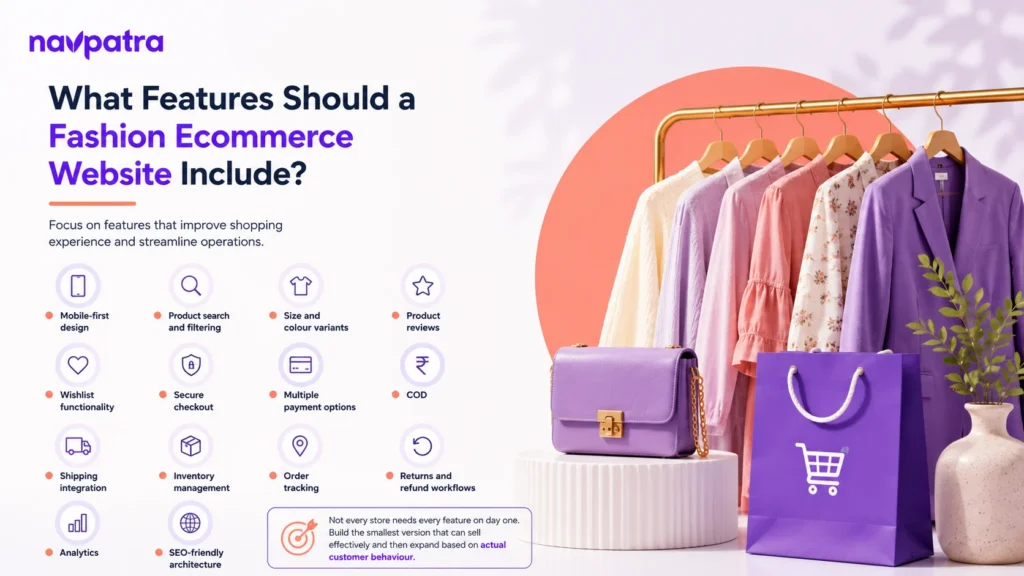
Your development budget should prioritize features that directly affect shopping and operations. A professional fashion ecommerce website should normally include:
- Mobile-first design
- Product search and filtering
- Size and colour variants
- Product reviews
- Wishlist functionality
- Secure checkout
- Multiple payment options
- COD
- Shipping integration
- Inventory management
- Order tracking
- Returns and refund workflows
- Analytics
- SEO-friendly architecture
Not every store needs every feature on day one.
For example, a new clothing startup may not need advanced personalization or AI recommendations. A large fashion retailer with thousands of customers might benefit significantly from them.
The goal should be to build the smallest version that can sell effectively and then expand based on actual customer behaviour.
How Can You Reduce Fashion Ecommerce Website Cost in India?
The easiest way to control the fashion ecommerce website cost in India is not to hire the cheapest developer.
It is to control the project scope.
Start by defining exactly what your first version needs.
For example, if you have 50 products, you probably do not need an expensive enterprise architecture. A Shopify or WooCommerce store with a professional theme and carefully selected integrations may be enough.
You can also reduce costs by preparing your content before development begins. Have your:
- Product descriptions
- Product photographs
- Prices
- SKUs
- Size charts
- Shipping rules
- Return policy
- Brand guidelines
ready before development starts.
It reduces delays and prevents developers from charging additional hours for content preparation or repeated revisions.
What Should You Ask a Web Development Company Before Hiring?
Do not accept a quotation that simply says “Ecommerce website – ₹1 lakh.”
Ask what that amount actually includes.
A good proposal should clearly explain the scope, including the number of pages, product setup, design process, integrations, payment gateway, shipping, SEO, testing, training, and post-launch support.
You should also clarify whether third-party costs are included. For example, ask whether the quote covers:
- Premium theme or plugin licences
- Payment gateway integration
- Shipping integration
- Product uploading
- SEO setup
- Analytics configuration
- SSL and hosting
- Maintenance
- Bug fixing after launch
- Future feature development
Is a ₹50,000 Fashion Ecommerce Website Enough?
It can be, but you need to understand what you are getting.
A ₹50,000 store may work for a small catalogue with a ready-made theme and standard functionality.
It is unlikely to include extensive custom design, advanced integrations, sophisticated product filtering, custom checkout development, or enterprise-level performance work.
The problem is not that inexpensive ecommerce websites are automatically bad.
The problem occurs when businesses expect a low-cost website to deliver the functionality of a ₹3 lakh or ₹5 lakh ecommerce project.
Your budget should match your requirements.
Final Verdict: What Is the Right Fashion Ecommerce Website Budget?
So, what is the realistic fashion ecommerce website cost in India?
For a new clothing brand, ₹80,000–₹1.5 lakh is a practical starting range for a professional store. A growing D2C brand may need ₹1.5 lakh–₹4 lakh, while complex or enterprise fashion ecommerce projects can move into the ₹5 lakh–₹15 lakh+ range.
The final price depends on your platform, catalogue, design, integrations, customization, and business requirements. Current Indian market estimates support a wide range because ecommerce projects vary significantly in complexity.
More importantly, don’t treat your website as a one-time development expense.
Your real ecommerce budget includes development, platform fees, payment processing, hosting, applications, photography, marketing, maintenance, and future improvements.
A practical approach is to launch with the features your customers genuinely need, measure how they use the store, and invest more as the business grows.