


Social media has changed how fashion brands attract customers, showcase collections, and build lasting relationships with their audiences.
Customers no longer rely solely on store visits or traditional advertisements to discover clothing brands. They explore Instagram feeds, watch styling videos, follow creators, and read customer reviews before deciding what to buy.
For fashion businesses, this shift creates a significant opportunity. A well-planned social media presence can help a brand increase visibility, communicate its identity, generate website traffic, and convert followers into paying customers.
However, posting attractive product photographs is not enough. Successful social media marketing for fashion brands requires a clear strategy that connects content, audience preferences, platform selection, and business goals.
Whether you run a new clothing label, an established D2C fashion business, or a growing ecommerce store, this guide explains how to build an effective social media strategy, create engaging content, and measure results.
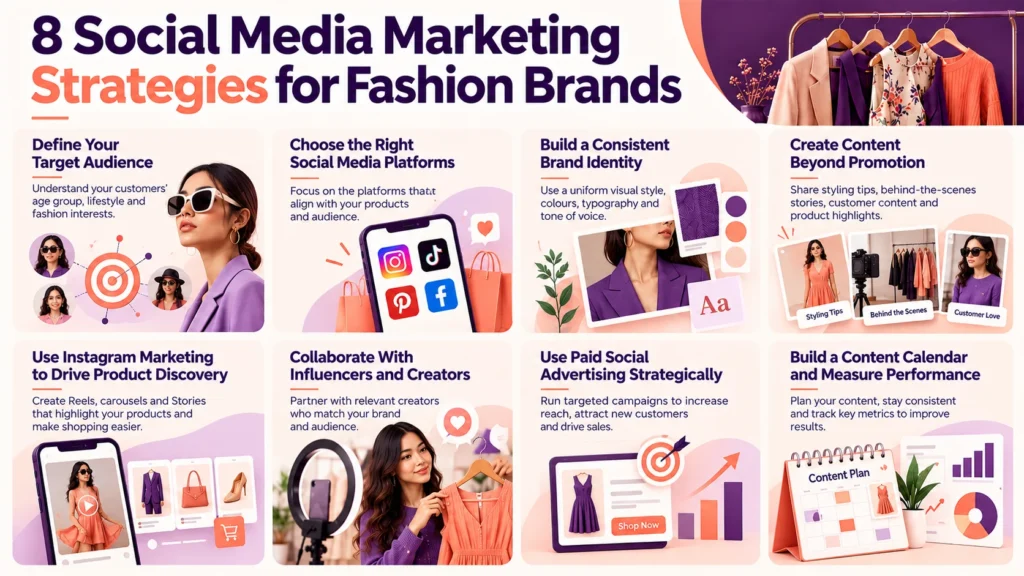
Understand customers’ preferences, budgets, and shopping behaviour to create relevant content.
Focus on channels such as Instagram, TikTok, and Pinterest based on your audience and business goals.
Maintain recognisable visuals, messaging, and tone across your social media profiles.
Balance styling tips, product showcases, behind-the-scenes videos, and customer-generated content.
Partner with relevant creators who align with your brand and target audience.
Test campaigns, retarget interested shoppers, and optimise spending based on conversions and profitability.
Use a content calendar to coordinate posts, product launches, seasonal campaigns, and promotions.
Track engagement, website traffic, conversion rates, customer acquisition costs, and revenue to improve results.
Why Social Media Marketing Matters for Fashion Brands?
Fashion is a visual industry. Customers want to see how clothes fit, how different pieces look together, and how products suit their personal style. Social media allows brands to communicate these details through photographs, videos, styling tutorials, and customer-generated content.
It also gives smaller businesses an opportunity to compete with established labels without relying entirely on expensive advertising campaigns. An effective strategy can help fashion brands:
Build brand awareness: Reach potential customers who have not discovered your products.
Showcase collections: Present new arrivals, seasonal launches, and styling combinations.
Build customer trust: Share reviews, real customer photographs, and behind-the-scenes content.
Drive website traffic: Direct interested audiences towards product pages and online stores.
Increase conversions: Use targeted campaigns, product demonstrations, and retargeting to encourage purchases.
Strengthen customer relationships: Respond to questions, gather feedback, and maintain conversations beyond individual transactions.
The real advantage comes from connecting these activities. Awareness introduces people to your brand, engaging content builds interest, and relevant product information helps customers make purchasing decisions.
8 Social Media Marketing Strategies for Fashion Brands
The eCommerce website price in Noida varies drastically based on the type of website, with single-vendor stores costing significantly less than complex multi-vendor marketplaces. Understanding which type of website your business needs is the first step in determining your budget.
Define Your Target Audience Before Creating Content
A fashion brand cannot appeal to everyone with the same message. A streetwear label targeting college students needs a different content strategy from a premium womenswear brand catering to working professionals.
Start by identifying your ideal customer’s age group, location, budget, lifestyle, shopping preferences, and fashion interests. Review existing customer data, website analytics, product sales, and social media interactions to understand who already buys from you.
Then build audience profiles around common needs and behaviours.
For example, a sustainable clothing brand might target consumers who value durable fabrics, ethical production, and versatile wardrobe essentials. Its content should explain material choices, garment care, and product longevity rather than focusing exclusively on discounts.
Use these insights to determine your brand voice, visual style, content themes, and platform priorities. A clearly defined audience makes your content more relevant and helps you spend marketing resources effectively.
Insights: About 94% of the time, users form their opinion about a website based on its design, and an average user takes only 0.05 seconds to decide how they feel about a website after landing on it.
Choose the Right Social Media Platforms
Every social platform serves a different purpose. Rather than maintaining an active presence everywhere, focus on the channels that align with your products and audience.
- Instagram: Instagram suits visual storytelling, product discovery, styling Reels, creator collaborations, customer content, and collection launches. Use Stories for polls, product questions, and launch reminders. Build a consistent feed that reflects your brand identity.
- TikTok: TikTok can help brands reach audiences through short videos, outfit transformations, styling challenges, and trend-led content. Focus on entertaining, useful, and authentic videos rather than making every post feel like an advertisement.
- Pinterest: Pinterest works well for outfit inspiration, seasonal fashion ideas, capsule wardrobes, and occasion-based styling. Create searchable pins that link to relevant product pages, collection pages, or useful fashion guides.
- Facebook: Facebook can support community engagement, catalogue-based advertising, promotions, and retargeting. It may be particularly useful for brands whose customers actively use Facebook groups or respond to local and interest-based campaigns.
Start with one or two primary platforms and establish a repeatable publishing process. Expand only when you have enough resources to maintain content quality and respond to your audience consistently.
Build a Consistent Fashion Brand Identity
Your social media presence should feel recognisable even when customers encounter individual posts outside your profile.
Develop clear guidelines for colours, typography, photography, video editing, captions, and tone of voice. These elements should reflect your positioning and remain consistent across campaigns.
A minimalist clothing label might use neutral backgrounds, natural lighting, and understated captions. A bold streetwear brand might prefer expressive styling, high-energy videos, and stronger graphic treatments.
Consistency does not mean repeating the same creative format. Experiment with product photography, styling videos, editorial shoots, customer stories, and behind-the-scenes footage while retaining recognisable brand elements.
Pay attention to the complete customer experience. Your social media visuals, website design, product descriptions, and packaging should communicate a coherent identity.
It helps customers understand what your brand stands for and makes your products easier to recognise across different channels.
Create Content That Goes Beyond Product Promotion
A profile filled entirely with product photographs and promotional offers can become repetitive. Customers need reasons to follow your brand beyond the opportunity to purchase something. Develop a balanced content mix that educates, entertains, inspires, and sells.
- Styling and educational content: Share outfit combinations, seasonal styling advice, fabric-care tips, and wardrobe essentials. This gives customers practical reasons to engage with your content.
- Behind-the-scenes stories: Show design decisions, fabric selection, production processes, photoshoots, and the people behind your brand. These stories make your business feel more personal.
- Customer-generated content: Share customer photographs, reviews, unboxing videos, and styling ideas with permission. Real experiences can help prospective buyers understand how products look and fit.
- Product-focused content: Highlight new arrivals, bestselling pieces, product details, outfit bundles, and collection launches. Explain the benefits and styling possibilities instead of relying only on promotional messages.
Use audience responses and performance data to refine this mix. The best content strategy is one that reflects your customers’ interests while supporting your commercial objectives.
Use Instagram Marketing to Drive Product Discovery
For many fashion businesses, Instagram is an important channel for presenting collections and helping shoppers discover new products. However, visibility alone does not guarantee sales.
Effective instagram marketing fashion strategies connect inspiring content with useful product information and clear next steps.
Create Reels that demonstrate how garments move, compare different fits, or show one item styled for multiple occasions. Use carousels to explain fabric details, sizing, outfit combinations, or product features. Keep Stories useful with restock updates, launch reminders, customer polls, and answers to common questions.
Your profile should make it easy for visitors to understand what you sell. Use a clear bio, organised Highlights, consistent product tags where available, and a direct link to your online store.
Also, review the questions customers ask repeatedly. If shoppers frequently request size guidance or fabric information, turn those questions into dedicated posts.
This approach makes your profile a product discovery and decision-support channel rather than simply a digital catalogue.
Collaborate With Fashion Influencers and Creators
Influencer partnerships can introduce your products to relevant audiences through styling videos, reviews, outfit inspiration, and authentic product demonstrations.
The key is to choose creators whose audiences match your target customers. A large follower count does not necessarily indicate strong engagement, purchasing intent, or relevance to your brand.
Evaluate potential partners based on audience demographics, content quality, engagement patterns, previous brand collaborations, and the relationship between their personal style and your products.
Start with smaller collaborations if your budget is limited. You could provide products for an honest review, arrange a paid styling video, or create a campaign around a specific collection.
Set clear expectations regarding deliverables, timelines, usage rights, payment, and disclosure of sponsored content. Track results using unique links, campaign codes, website analytics, and sales data where possible.
Measure the quality of the audience reached and the commercial outcomes, not just likes and views. Reinvest in partnerships that consistently deliver relevant traffic, engagement, or conversions.
Use Paid Social Advertising Strategically
Organic content helps brands build visibility over time, while paid campaigns can expand reach and target specific audiences. The strongest results often come from using both approaches together.
Begin by identifying the objective of each campaign. Awareness campaigns introduce your brand to new audiences, traffic campaigns attract website visitors, and conversion campaigns focus on measurable actions such as purchases.
Create different advertisements for different customer needs. A first-time visitor may respond to a styling video or product demonstration, while someone who previously viewed a product may need additional information, a customer review, or a relevant offer.
Retargeting can help reconnect with eligible website visitors and engaged users, subject to platform availability, consent requirements, and applicable privacy rules.
Test different creative formats, audience segments, product selections, and calls to action. Evaluate campaigns using metrics such as customer acquisition cost, conversion rate, return on ad spend, and contribution margin.
Avoid increasing budgets simply because an advertisement generates many clicks. Focus on whether the resulting customers and sales justify the cost.
Build a Content Calendar and Measure Performance
Consistency becomes difficult when content planning happens at the last minute. A content calendar helps your team coordinate product launches, seasonal campaigns, creator partnerships, and everyday publishing.
Plan content weekly or monthly. Assign each post a purpose, platform, format, publication date, and desired action. Leave room for timely trends and unexpected opportunities without abandoning your overall strategy.
For example, a fashion brand might publish styling advice early in the week, introduce a new product midweek, share customer content later, and feature a collection or offer over the weekend. Review performance regularly using relevant metrics:
- Reach and impressions: Understand how widely your content is distributed.
- Engagement rate: Evaluate interactions relative to your chosen audience or reach measure.
- Profile visits and link clicks: Measure interest in learning more about your products.
- Website conversion rate: Track the proportion of visitors who complete a desired action.
- Customer acquisition cost: Assess how much you spend to acquire a customer.
- Revenue and return on ad spend: Evaluate the commercial performance of campaigns.
Use these insights to identify successful formats, improve underperforming posts, and allocate resources more effectively. Measure performance against your business objectives instead of comparing every post using the same criteria.
Insights: A well-designed website can significantly increase engagement, with users spending up to 84% more time on your site, while also driving up to a 132% year-over-year growth in online revenue.
Common Social Media Marketing Mistakes Fashion Brands Should Avoid
Even a visually appealing profile can struggle to generate business results when the underlying strategy is weak.
Posting without a clear objective makes it difficult to understand whether content supports awareness, engagement, or sales. Give each campaign a defined purpose and measure its performance accordingly.
Following every trend can also dilute your brand identity. Participate only when a trend fits your audience, products, and communication style.
Another common mistake is ignoring comments and direct messages. Customers often use these channels to ask about sizes, delivery, returns, and product availability. Slow responses can create uncertainty and cost potential sales.
Finally, avoid judging success through follower counts alone. A smaller, relevant audience that visits your website and purchases products may be more valuable than a large audience with limited buying interest.
How to Build a Social Media Marketing Strategy for Your Fashion Brand?
If you are starting from scratch, use the following steps to create a manageable plan.
- Step 1: Set measurable goals. Decide whether your immediate priority is brand awareness, website traffic, customer acquisition, or repeat purchases.
- Step 2: Research your audience. Identify customer preferences, common questions, shopping habits, and the platforms they use.
- Step 3: Establish your content pillars. Choose recurring themes such as styling advice, product education, customer stories, and collection launches.
- Step 4: Create a publishing calendar. Plan content in advance and assign responsibilities for creation, approval, publishing, and community management.
- Step 5: Test campaigns. Experiment with creative formats, collaborations, and paid advertisements using manageable budgets.
- Step 6: Review and improve. Analyse performance, identify successful approaches, and update your strategy based on customer behaviour.
Start with a realistic publishing schedule. It is better to maintain a consistent standard of quality than to publish frequently without a clear purpose.
Insights: On average, it takes about 2.6 seconds for a user’s eyes to focus on the most important areas of a web page.
The Final Words
Social media can become a valuable growth channel when fashion brands connect creative storytelling with measurable business goals.
Attractive visuals may capture attention, but useful content, relevant partnerships, responsive communication, and a smooth shopping experience help turn that attention into customer relationships.
Successful social media marketing for fashion brands requires ongoing experimentation. What works for a premium clothing label may not work for an affordable streetwear brand, and platform performance can change as customer preferences evolve.
Focus on understanding your audience, selecting suitable platforms, building a recognisable identity, and measuring the results that matter to your business.