

Acquiring a new customer is only the beginning of building a profitable fashion business. The real opportunity lies in giving customers a reason to return, explore new collections, and choose your brand over competing retailers.
This is where loyalty programs for fashion brands can make a measurable difference. When designed around customer behaviour, product preferences, and purchase frequency, loyalty programs can encourage repeat orders, strengthen brand relationships, and improve customer lifetime value.
However, simply offering points or discounts does not guarantee loyalty. Fashion brands need a structured retention strategy that combines relevant rewards, personalised communication, reliable customer experiences, and profitability tracking.
Loyalty programs help fashion brands encourage repeat purchases, strengthen customer relationships, and improve customer lifetime value.
Points-based rewards, tiered memberships, exclusive access, referral incentives, and community programs support different retention goals.
Use purchase history, product preferences, and customer behaviour to deliver relevant rewards and recommendations.
Design reward structures around contribution margins and incremental purchases rather than revenue alone.
Connect loyalty data with ecommerce platforms, CRM tools, and marketing channels to create a consistent customer experience.
What Are Customer Loyalty Programs for Fashion Brands?
Customer loyalty programs reward customers for purchasing from a brand and, in some cases, engaging with its community. Rewards may include points, exclusive collections, early access, personalised offers, referrals, birthday benefits, or special services.
For a fashion ecommerce business, a loyalty program connects customer data with retention marketing. It can help identify frequent buyers, recognise high-value customers, re-engage inactive shoppers, and encourage customers to discover complementary products.
The objective is not simply to generate another transaction. It is to increase the likelihood that customers return because they find ongoing value in the brand.
Shopify’s customer retention guidance similarly identifies loyalty programs, referral incentives, personalised communication, and improved customer experiences as complementary retention strategies.
Why Fashion Brands Need a Customer Retention Strategy?
Fashion purchases are influenced by changing seasons, personal style, occasions, trends, and wardrobe requirements. It creates opportunities for brands to build repeat purchasing habits, although the natural purchase frequency differs between categories.
A customer buying everyday basics may return more frequently than someone purchasing occasionwear. A loyalty strategy should account for these differences rather than treating every customer identically. A well-designed program can help fashion brands:
Increase repeat purchases by giving customers a relevant reason to shop again.
Improve customer lifetime value by developing longer-lasting relationships.
Encourage product discovery through recommendations and collection previews.
Reduce excessive discount dependence by offering benefits beyond price reductions.
Generate referrals through customers who genuinely appreciate the brand.
Strengthen first-party customer insights for more relevant retention campaigns.
Customer retention should also be considered alongside product quality, delivery reliability, sizing accuracy, and returns management. Rewards cannot compensate for a consistently disappointing shopping experience.
Types of Loyalty Programs Fashion Brands Can Use
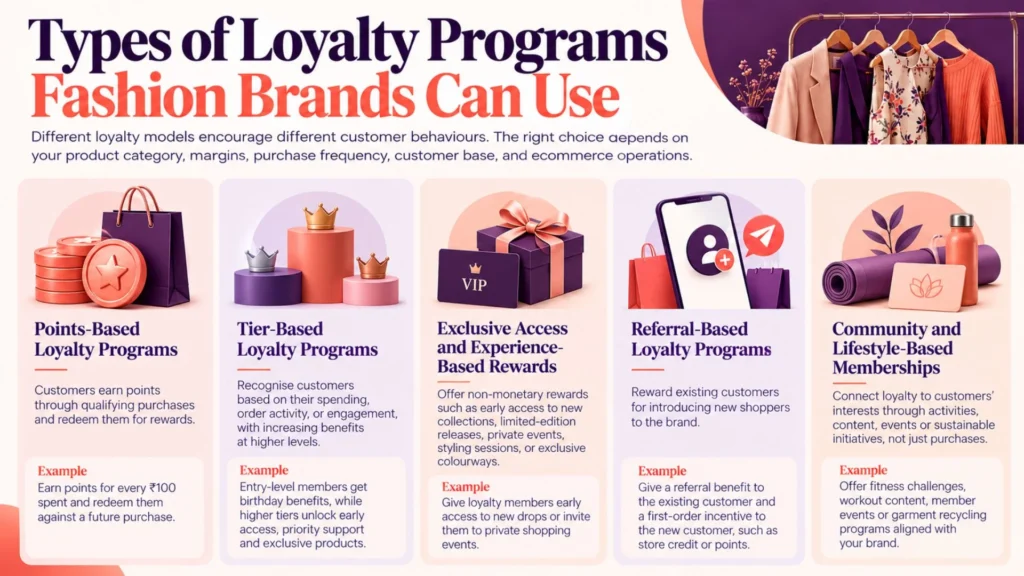
Different loyalty models encourage different customer behaviours. The right choice depends on your product category, margins, purchase frequency, customer base, and ecommerce operations.
Points-Based Loyalty Programs
Points-based programs allow customers to earn points through qualifying purchases and redeem them for rewards. For example, a clothing brand might award points for every ₹100 spent and allow members to redeem accumulated points against a future purchase.
This approach is relatively easy for customers to understand and can encourage them to return before considering competing brands.
However, reward economics matter. If the value of points is too low, customers may ignore the program. If it is too generous, the brand may sacrifice margin without creating genuinely incremental purchases.
Set an earning rate and redemption threshold based on contribution margins, average order value, product returns, and expected purchase behaviour. Make the rules simple enough for customers to understand without calculating complicated reward conditions.
Insights: About 94% of the time, users form their opinion about a website based on its design, and an average user takes only 0.05 seconds to decide how they feel about a website after landing on it.
Tier-Based Loyalty Programs
Tier-based programs recognise customers according to their qualifying spending, order activity, or other meaningful engagement. A fashion brand might create three membership levels, with benefits increasing as customers progress.
For instance, members at the entry level could receive birthday benefits, while higher tiers could unlock early access to collections, priority customer support, exclusive products, or selected delivery benefits.
The advantage is that tiers recognise customer value without relying entirely on blanket discounts.
However, tier thresholds should reflect actual purchasing patterns. If customers rarely buy often enough to reach the next level, the program may feel irrelevant. Review the distribution of customer spending and purchase frequency before setting thresholds.
Exclusive Access and Experience-Based Rewards
Fashion is closely connected to personal identity, discovery, and self-expression. That makes non-monetary rewards particularly relevant.
Consider offering loyalty members early access to new collections, limited-edition releases, private shopping events, styling sessions, or exclusive colourways.
These benefits can reinforce a brand’s positioning without reducing the selling price of every product.
For premium and designer brands, exclusive access may be more consistent with the brand experience than frequent discount vouchers. For trend-led brands, early access to new drops may encourage customers to return for each launch.
The key is to offer benefits that customers genuinely value rather than adding perks simply to make the program appear more elaborate.
Referral-Based Loyalty Programs
Referral programs reward existing customers for introducing new shoppers to the brand. A clothing brand could provide a referral benefit to an existing customer and a first-order incentive to the new customer. Rewards might be store credit, points, or access to selected benefits.
To make the program financially sustainable, calculate the cost of the reward against the contribution margin from the referred order.
Define when the reward becomes eligible. For example, you may issue referral benefits only after the referred order is delivered and the return window has passed. This helps reduce abuse involving cancelled orders or returned purchases.
Referral programs work best when customers already have a positive product experience. Incentivising recommendations before establishing trust is unlikely to create sustainable advocacy.
Community and Lifestyle-Based Memberships
Some fashion brands can build stronger relationships by connecting loyalty to customers’ interests rather than purchases alone.
An activewear brand might offer fitness challenges, workout content, member events, or partnerships with relevant communities. A sustainable fashion label could recognise garment recycling or provide product-care education alongside purchase rewards.
This approach can make the brand more engaging between transactions.
However, non-purchase activities should be easy to verify and aligned with the brand. Avoid rewarding low-value interactions merely to inflate engagement metrics.
How to Design an Effective Loyalty Program for a Fashion Brand?
Choosing a loyalty model is only one part of the process. To generate business value, your program must align with your retention goals, profit margins, customer journey, and technology.
Start With One Clear Business Objective
Define what you want to achieve before selecting rewards. Focus on one primary objective to keep the program measurable and effective.
Increase repeat purchases by encouraging first-time buyers to shop again.
Shorten the purchase cycle by motivating customers to return sooner.
Improve customer retention by giving existing customers compelling reasons to stay loyal.
Increase profitable order value through relevant product bundles and spending-based rewards.
Generate more referrals by rewarding customers who introduce new shoppers to your brand.
Segment Customers by Behaviour
Different customers respond to different incentives. Use purchase history and engagement data to create relevant loyalty experiences.
First-time buyers: Offer product recommendations, styling guidance, or incentives for a second purchase.
Frequent customers: Provide exclusive access to new collections, limited-edition products, or special events.
High-value customers: Reward consistent spending with premium benefits and personalised experiences.
Inactive customers: Encourage them to return with relevant product recommendations or time-limited offers.
Category-specific shoppers: Share new arrivals based on their preferred categories, such as casualwear, ethnicwear, or occasionwear.
Protect Profitability When Setting Rewards
A loyalty program may increase repeat purchases but still reduce profits if rewards are too expensive. Evaluate the full cost of each benefit before introducing it.
Calculate reward costs by accounting for discounts, free shipping, product giveaways, technology, administration, and fulfilment.
Set margin-based thresholds instead of relying on revenue targets alone.
Avoid unnecessary discounts on purchases customers would have made at full price.
Consider lower-cost benefits such as early access, exclusive collections, styling recommendations, and members-only content.
Measure incremental purchases to determine whether rewards generate additional sales or simply reduce margins on existing demand.
Review contribution margin alongside repeat purchase rate and average order value to ensure the program supports profitable growth.
Connect Loyalty With Your Ecommerce Systems
Integrate your loyalty program with your existing ecommerce operations to create a consistent customer experience.
Connect key platforms such as your ecommerce store, CRM, email marketing tools, WhatsApp marketing tools, and order management systems where supported.
Define reward rules for cancelled orders, refunds, exchanges, and returned products.
Set clear expiry policies so customers understand how long their points or rewards remain valid.
Make rewards accessible by allowing customers to check their points, available benefits, and redemption options easily.
Manage customer consent by collecting only necessary information, communicating transparently, and respecting marketing preferences.
Monitor program performance through integrated reporting on redemptions, repeat purchases, customer retention, and profitability.
For Indian fashion ecommerce brands, clear reward terms and appropriate handling of customer data are particularly important for building trust and maintaining a reliable loyalty experience.
Insights: A well-designed website can significantly increase engagement, with users spending up to 84% more time on your site, while also driving up to a 132% year-over-year growth in online revenue.
Real-World Examples of Fashion Loyalty Programs
Established brands demonstrate how different loyalty mechanics can work together.
H&M Membership in India offers points on purchases, bonus vouchers, special offers, sale pre-access, and additional benefits for Plus members. It also recognises selected activities beyond purchases, including garment recycling and bringing a reusable bag in-store.
adidas adiClub in India combines purchase-based points with product and experience rewards. Members can also earn points through activities such as writing product reviews and tracking workouts through the adidas Running app. Higher membership levels unlock additional benefits, including early access to selected launches and priority services.
These programs illustrate two useful principles. First, rewards need not be limited to discounts. Second, the most relevant activities depend on the brand’s product category and customer relationship.
Smaller fashion businesses do not need to replicate the complexity of a global brand. A simple points system, referral benefit, or early-access program may be a better starting point.
How to Measure Loyalty Program Performance?
Membership numbers alone do not prove that a loyalty program is successful. A large number of sign-ups can look impressive while generating little incremental revenue. Fashion brands should measure several indicators together. Some of the main indicators are:
- Repeat purchase rate shows what proportion of customers purchase again within a defined period.
- Time to second purchase reveals how long customers take to return after their first order. This can inform the timing of post-purchase communication.
- Customer lifetime value (CLV) estimates the economic value of a customer relationship over time. Define the calculation consistently and avoid treating projected lifetime value as guaranteed revenue.
- Reward redemption rate indicates whether customers use the benefits they earn. Very low redemption may suggest that rewards are unattractive or difficult to access.
- Incremental contribution margin helps determine whether additional purchases generated by the program outweigh the costs of rewards and administration.
- Also track retention by customer cohort, return rates, referral conversion, and the proportion of reward-driven sales that would likely have occurred without an incentive.
Where possible, compare participating customers with a comparable group that does not receive the same loyalty intervention. This helps separate the program’s actual effect from the behaviour of customers who were already highly loyal.
Common Loyalty Program Mistakes to Avoid
Fashion brands often weaken their programs by making them unnecessarily complicated or focusing only on discounts.
Avoid setting reward thresholds that most customers can never realistically reach. Do not change rules without clearly communicating the changes. Avoid sending irrelevant promotions to every member, and do not measure success purely through enrolment or redemption.
Another common mistake is launching a loyalty program before resolving operational problems. Incorrect sizing, poor product quality, delayed shipping, or difficult returns can discourage repeat purchases regardless of the rewards offered.
A stronger approach is to establish a reliable customer experience first, then use loyalty benefits to strengthen an already positive relationship.
Insights: On average, it takes about 2.6 seconds for a user’s eyes to focus on the most important areas of a web page.
Conclusion
Loyalty programs for fashion brands work best when they offer customers meaningful value while supporting clear business objectives.
Start by identifying the retention behaviour you want to improve. Choose a suitable reward structure, segment customers according to their needs, protect contribution margins, and connect the program with your ecommerce operations.
Most importantly, measure whether the program creates incremental profitable purchases rather than simply rewarding existing behaviour.
For fashion brands looking to improve fashion customer retention, a well-managed loyalty program can become an important part of a broader ecommerce strategy built around product quality, personalised communication, customer experience, and repeat purchasing.