



A fashion brand can attract customers, generate strong sales, and build a loyal audience, yet struggle to remain profitable. One of the biggest reasons is poor inventory management. Excess stock ties up cash, popular products run out too quickly, and seasonal collections lose value before brands can sell them.
These challenges become more complicated as a fashion business grows. A brand that once managed products through spreadsheets may suddenly need to coordinate multiple sales channels, hundreds of SKUs, changing customer preferences, and frequent product launches.
Effective inventory management for fashion brands is about more than tracking products in a warehouse. It involves understanding what customers want, predicting demand, maintaining the right stock levels, and making informed purchasing decisions.
In this guide, we explore practical inventory management strategies, common mistakes to avoid, and the tools that can help fashion businesses build a more efficient supply chain.
Use historical sales, seasonal trends, and customer preferences to plan purchases and avoid excess stock.
Maintain SKU-level records for sizes, colours, sales, returns, and available inventory across all sales channels.
Apply ABC analysis to focus on products that contribute significantly to revenue and profitability.
Combine supplier lead times, average demand, and safety stock to prevent stockouts without overstocking.
Track inventory turnover, sell-through rates, stockout rates, and dead stock value to identify inefficiencies.
Test emerging trends with smaller batches and establish markdown timelines for unsold products.
Work with reliable suppliers to maintain product quality, manage lead times, and minimise disruptions
Why Inventory Management Matters for Growing Fashion Brands?
Fashion inventory comes with challenges that many other retail categories do not face to the same extent. A single T-shirt design might have five sizes, four colours, and several variations. Each combination requires accurate stock tracking.
At the same time, consumer preferences change quickly. A product that sells well today may lose demand after a new trend emerges.
Seasonal collections, festive shopping periods, and unpredictable demand can make purchasing decisions even more difficult. Poor inventory control creates several problems:
- Excess inventory: Unsold products occupy storage space and lock up working capital.
- Stockouts: Popular sizes and designs become unavailable, resulting in missed sales.
- Markdown pressure: Slow-moving products require discounts that reduce profit margins.
- Fulfilment delays: Inaccurate stock records can lead to cancellations and delayed deliveries.
- Poor purchasing decisions: Without reliable sales data, brands may invest in products customers do not want.
A well-planned inventory system helps businesses balance product availability with profitability. It also gives founders and ecommerce teams better visibility into purchasing requirements, sales performance, and cash flow.
10 Inventory Management Tips for Growing Fashion Brands
Effective inventory management starts with understanding demand, maintaining accurate stock records, and making informed purchasing decisions.
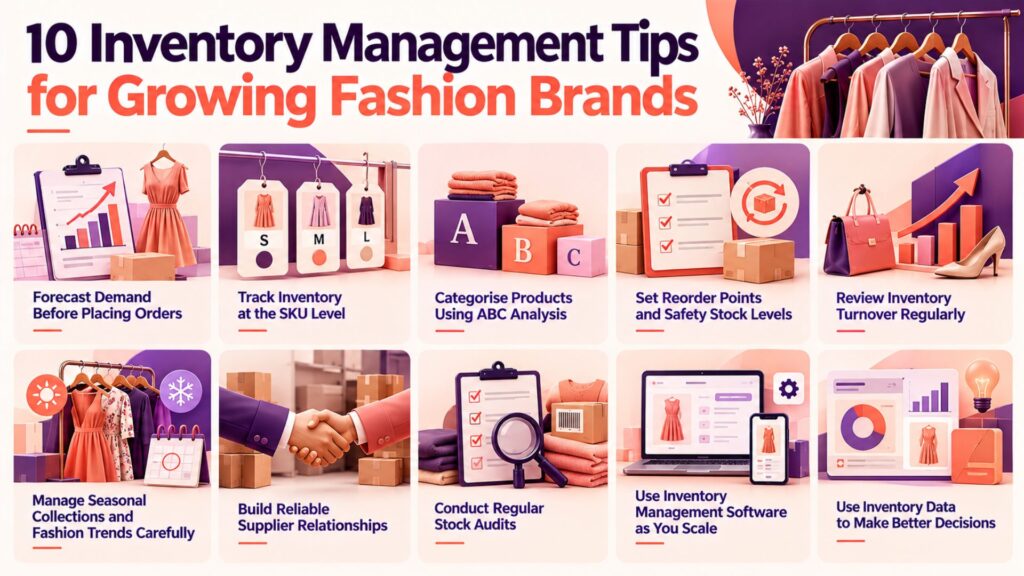
The following ten strategies will help fashion brands reduce excess inventory, prevent stockouts, streamline operations, and maintain profitability as they scale.
Forecast Demand Before Placing Orders
Analyse historical sales, seasonal trends, promotions, and customer preferences before purchasing inventory. Identify bestselling products and anticipate demand fluctuations.
For new collections, test demand through pre-orders or small production batches. It reduces overstocking, prevents stockouts, and helps you make data-driven purchasing decisions.
Track Inventory at the SKU Level
Track every product variation, including size, colour, and design, using unique SKUs. Maintain accurate records of available stock, sales, returns, damaged products, and incoming orders.
Synchronise inventory across your website, marketplaces, and physical stores to prevent overselling and fulfilment errors.
Insights: About 94% of the time, users form their opinion about a website based on its design, and an average user takes only 0.05 seconds to decide how they feel about a website after landing on it.
Categorise Products Using ABC Analysis
Use ABC analysis to prioritise products according to their financial importance. Category A includes high-value products requiring close monitoring, Category B covers moderately important items, and Category C includes lower-value products.
You can combine revenue, sales frequency, and margins to establish appropriate replenishment priorities.
Set Reorder Points and Safety Stock Levels
Calculate reorder points using average daily demand, supplier lead time, and safety stock.
For example, selling 12 units daily with a 10-day lead time and 40 safety units requires a 160-unit reorder point.
Adjust these thresholds according to demand fluctuations and supplier reliability.
Review Inventory Turnover Regularly
Calculate inventory turnover by dividing the cost of goods sold by average inventory value. Monitor this metric across product categories and seasons.
Low turnover may indicate excess stock, while unusually high turnover could signal understocking. Balance product availability with efficient working capital utilisation.
Manage Seasonal Collections and Fashion Trends Carefully
Avoid committing heavily to untested trends. Start with smaller production batches and replenish products that sell well. Plan seasonal purchases around launch dates, supplier lead times, and expected demand.
You should establish markdown timelines to clear unsold collections before they lose commercial value.
Build Reliable Supplier Relationships
Evaluate suppliers based on product quality, delivery timelines, minimum order quantities, and communication. Share demand forecasts to improve production planning and reduce delays.
Maintain backup suppliers for critical products where practical, and establish consistent quality standards to minimise disruptions and manufacturing inconsistencies.
Conduct Regular Stock Audits
Compare physical stock with inventory records to identify damaged products, misplaced items, returns, and recording errors. Use cycle counting to inspect selected SKUs regularly instead of counting everything simultaneously.
Also investigate recurring discrepancies to improve stock accuracy, reduce cancellations, and strengthen purchasing decisions.
Use Inventory Management Software as You Scale
Adopt inventory software when spreadsheets become difficult to maintain. Prioritise SKU tracking, low-stock alerts, purchase order management, returns processing, and multichannel synchronisation.
Integrate relevant ecommerce and warehouse systems, standardise product records, and train employees to maintain accurate, consistent inventory data.
Use Inventory Data to Make Better Decisions
Monitor sell-through rates, stockout rates, inventory turnover, gross margins, return rates, and dead stock value. Analyse these metrics together to identify purchasing inefficiencies and profitability issues.
Review performance monthly and adjust pricing, replenishment, promotions, and product assortment according to the findings.
Insights: A well-designed website can significantly increase engagement, with users spending up to 84% more time on your site, while also driving up to a 132% year-over-year growth in online revenue.
Common Inventory Management Mistakes Fashion Brands Should Avoid
Even businesses with established processes can lose money through preventable inventory mistakes.
Overbuying to secure lower manufacturing prices is one example. Bulk orders may reduce unit costs, but the savings can disappear when unsold products require heavy discounts or additional storage.
Another mistake is relying entirely on historical sales without considering current conditions. A product’s past performance does not guarantee future demand, especially when trends, pricing, competition, or customer preferences change.
Brands should also avoid treating every sales channel as a separate inventory pool without a clear allocation strategy. Poor coordination between marketplaces, websites, and physical stores can result in overselling or products remaining unavailable where demand is strongest.
Finally, do not ignore returns. Returned clothing may need inspection, repackaging, repairs, or removal from sellable inventory. Failing to process these changes promptly creates inaccurate stock figures.
The most effective approach is to establish consistent purchasing, receiving, selling, return, and audit procedures that every team member follows.
How to Build an Inventory Management System for Your Fashion Brand?
If your current inventory process feels difficult to manage, start with a structured implementation plan rather than changing everything at once.
- Step 1: Audit your existing inventory. Count physical stock, identify discrepancies, and separate sellable products from damaged or obsolete items.
- Step 2: Standardise your product catalogue. Assign unique SKUs to every relevant product variation and maintain consistent product descriptions.
- Step 3: Analyse sales performance. Identify bestsellers, slow-moving products, seasonal patterns, and items that frequently run out of stock.
- Step 4: Establish replenishment rules. Set reorder points, safety stock levels, and purchasing schedules based on demand and supplier lead times.
- Step 5: Choose suitable tools. Improve your existing spreadsheet process or introduce inventory software when manual tracking becomes unreliable.
- Step 6: Monitor performance. Review inventory metrics, investigate discrepancies, and update purchasing decisions as demand changes.
Implement these steps gradually. A reliable process that your team follows consistently will deliver more value than a complicated system that lacks clear ownership.
Insights: On average, it takes about 2.6 seconds for a user’s eyes to focus on the most important areas of a web page.
Conclusion
Inventory management becomes increasingly important as fashion brands expand their product ranges, sales channels, and customer base. Without reliable processes, growth can create cash flow pressure, operational inefficiencies, and missed revenue opportunities.
As your business scales, treat inventory as a strategic asset rather than simply a collection of products in storage. Better control over stock can help you protect margins, improve customer experience, and build a fashion business that grows with greater confidence.