


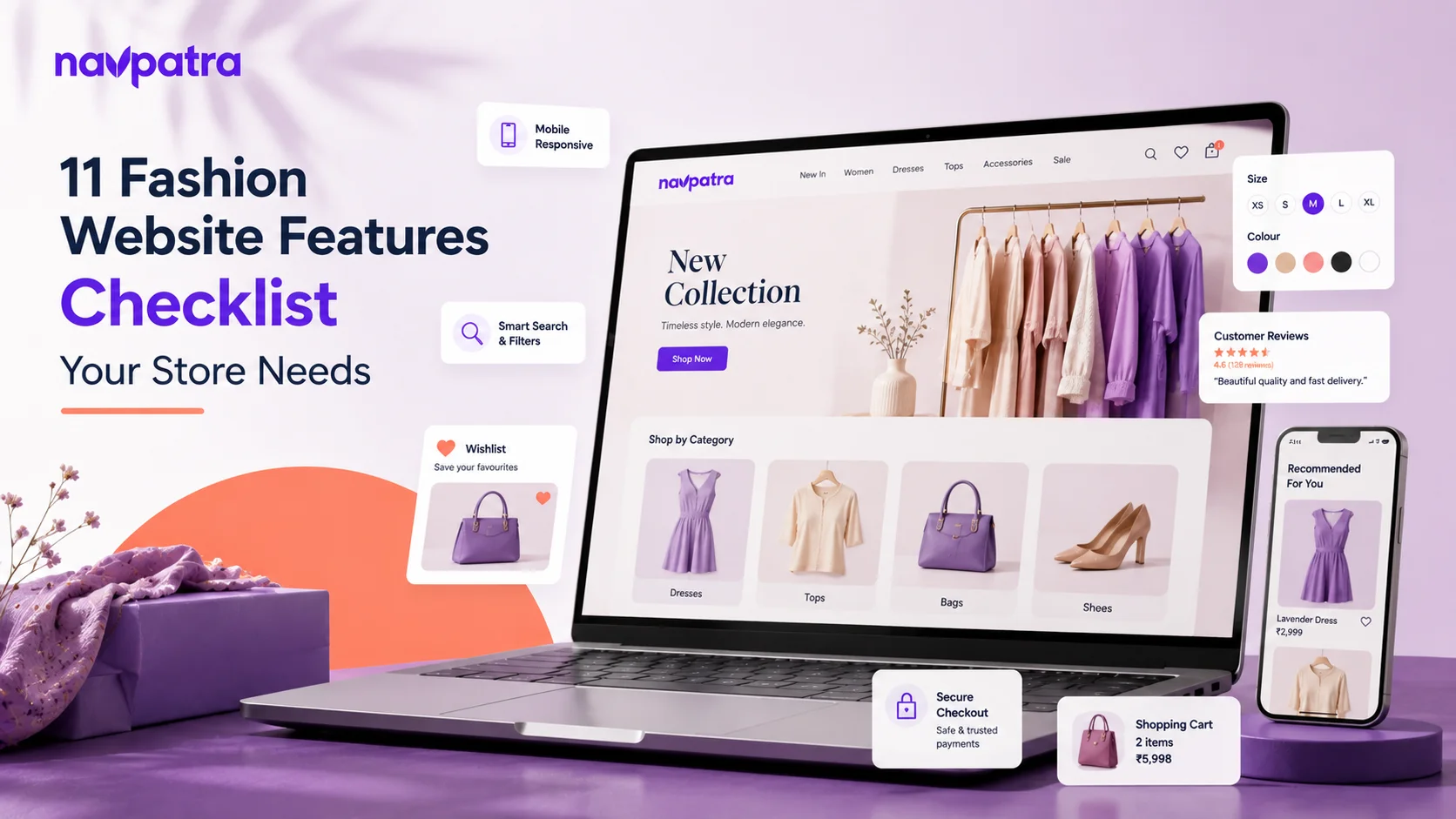
A fashion ecommerce website needs to do more than look visually appealing. It must help shoppers discover products, understand fit and sizing, compare options, make secure payments, and complete purchases without friction.
It also needs a technical foundation that supports search visibility, analytics, performance, and future growth.
Before launching, use this ecommerce website checklist fashion brands can follow to review the complete customer journey.
The right fashion website features should solve real customer problems instead of simply adding more functionality.
Key Takeaways
- A fashion ecommerce website should prioritize usability, conversions, performance, SEO, and security, not just visual appeal.
- Mobile-first responsive design is essential because shoppers need a smooth browsing and checkout experience across devices.
- Clear navigation, logical categories, smart product filters, and search help customers find products faster.
- High-quality images and videos should showcase fabric, fit, colours, details, and product quality while remaining optimized for performance.
- Product pages should provide complete information about sizes, measurements, materials, fit, care, stock, delivery, and returns.
11 Crucial Fashion Website Features You Need Before Launch
The fashion ecommerce website cost in India typically falls between ₹60,000 and ₹8 lakh for most small to mid-sized brands, while enterprise-grade or highly customized stores can cost considerably more.
A practical budget depends largely on the type of store you want to build.
Mobile-First Responsive Design
A fashion store must work smoothly on smartphones, tablets, and desktops. Mobile visitors should be able to browse categories, use filters, view product images, select variants, add products to the cart, and complete checkout without zooming or struggling with small buttons.
Test the complete purchase journey on real mobile devices before launch. Pay particular attention to product galleries, sticky buttons, navigation, size selectors, and checkout. Mobile usability issues can directly affect conversions.
Clear Navigation and Product Categories
Customers should reach relevant products within a few clicks. Organize your catalogue around the way shoppers search, using categories such as Women, Men, Dresses, Shirts, Jeans, Accessories, New Arrivals, and Sale where appropriate.
Keep the hierarchy logical. For example: Women → Dresses → Maxi Dresses → Product
A clear structure improves usability and also helps search engines understand the relationships between ecommerce pages. Google recommends logical navigation and internal linking to help it discover and understand important products and categories.
Product Search and Smart Filters
Search and filtering become increasingly important as your catalogue grows. A shopper looking for a black dress in size M should not have to browse hundreds of products manually.
Useful filters can include:
- Size
- Colour
- Price
- Material
- Fit
- Pattern
- Product type
- Availability
Make sure your product attributes remain consistent. If your catalogue uses different names for the same colour or material, filters can become confusing and less useful.
It is an important part of an ecommerce website checklist fashion brands should complete before launch because poor filtering can make a large catalogue difficult to navigate.
High-Quality Product Images and Videos
Customers cannot touch or try on clothing online, so product visuals need to communicate as much information as possible.
Use multiple angles, close-up details, model photography, and short videos when they add value. Show details such as fabric texture, stitching, fit, and design elements that customers may want to inspect before purchasing.
At the same time, optimize image files. Large, uncompressed fashion photography can slow down product pages and negatively affect the user experience.
Detailed Product Pages With Size Information
Your product page should answer the questions a customer would normally ask in a physical store. Include the:
- Material
- Fit
- Available sizes
- Colours
- Measurements
- Care instructions
- Stock availability
- Delivery information
- Return conditions
Size information deserves particular attention. Add a clear size chart and explain how customers should measure themselves when necessary.
You can also include practical information such as: Model is 5’8″ and wearing size M. It gives customers useful context that a simple S, M, L, or XL selector cannot provide.
Insights: About 94% of the time, users form their opinion about a website based on its design, and an average user takes only 0.05 seconds to decide how they feel about a website after landing on it.
Accurate Size and Colour Variant Management
Fashion products commonly have several variants. A single dress could have multiple sizes and colours, with different inventory levels for each combination.
Your website should make variant selection simple and show availability clearly. If a customer chooses a particular colour, displaying the corresponding product image can remove uncertainty. If a size is unavailable, clearly mark it as unavailable.
It also matters for SEO. Google provides specific structured-data guidance for apparel variants such as size, colour, material, and pattern.
Google also recommends that ecommerce websites structure variant URLs consistently when variants need to be individually identifiable.
Fast and Secure Checkout
A customer who reaches checkout has already shown strong purchase intent. Do not create unnecessary obstacles at this stage. Your checkout should clearly show:
- Product and quantity
- Price
- Discounts
- Shipping charges
- Taxes where applicable
- Payment methods
- Final order amount
For Indian fashion ecommerce, consider payment methods such as UPI, cards, net banking, wallets, and COD where appropriate.
Before launch, test successful payments, failed transactions, refunds, cancellations, confirmation emails, and inventory updates. A payment gateway may appear correctly connected while the underlying order workflow still contains errors.
Shipping, Returns, and Order Tracking
Customers want to know when their order will arrive and what happens if the product does not work for them.
Clearly communicate delivery locations, estimated delivery times, shipping charges, COD availability, tracking, return windows, and refund procedures.
Do not hide these details only inside a policy page. Important information should be accessible from product pages and checkout.
For fashion brands, transparent returns are particularly important because shoppers cannot physically assess fit before purchasing.
It is another essential part of an ecommerce website checklist fashion businesses should complete before going live.
Customer Reviews and Social Proof
Reviews help shoppers make decisions when they cannot physically inspect a product. For fashion, reviews become particularly useful when customers discuss fit, fabric quality, colour accuracy, comfort, and sizing.
Photo reviews can provide even more useful context because potential customers can see products on real people.
Place reviews close to important product information rather than hiding them at the very bottom of the page. Use authentic reviews and avoid fabricated ratings because trust is one of the most valuable assets for a new fashion brand.
SEO-Friendly Architecture and Structured Data
SEO should be considered during development, not after the website launches.
Your website should have descriptive URLs, unique title tags, useful meta descriptions, logical internal links, canonical URLs, optimized images, and an XML sitemap.
Structured data is also important. Google states that ecommerce structured data can help it understand product information and potentially present products more effectively across relevant search experiences.
For fashion stores, product variants deserve special attention. Google specifically supports ProductGroup and Product structured data for products that vary by attributes such as size, colour, material, and pattern.
For AI search and answer systems, clear product information matters for the same reason. Keep important information explicit, consistent, and easy for machines to interpret rather than relying on images or vague marketing language.
Analytics, Performance, and Security
You need to know what customers do after they reach your website. Set up analytics before launch and track important ecommerce actions such as product views, searches, add-to-cart events, checkout starts, purchases, and refunds.
This information can reveal where customers are leaving. For example, many product views with few add-to-cart actions may indicate problems with pricing, product information, images, reviews, or sizing.
Performance also deserves testing. Check the homepage, category pages, product pages, cart, and checkout. Compress images, remove unnecessary scripts, and review third-party apps that could slow down important pages.
Your technical ecommerce website checklist fashion teams use before launch should also cover HTTPS, secure payment integration, backups, administrator access controls, software updates, and third-party integrations.
Insights: A well-designed website can significantly increase engagement, with users spending up to 84% more time on your site, while also driving up to a 132% year-over-year growth in online revenue.
Final Launch Check
The best fashion website features are not necessarily the most advanced ones. They are the features that remove friction from the customer journey. Before launch, ask:
- Can customers find products quickly?
- Can they understand the product and its fit?
- Can they select the correct size and colour?
- Can they pay using a convenient and secure method?
- Can they understand shipping and returns before purchasing?
- Can search engines understand your products and variants?
- Can you measure what happens after customers arrive?
If the answer is yes, your store has a strong foundation.