


Your customer finds the perfect outfit. They choose a size, pick a colour, and head to checkout. Then something goes wrong. The page takes too long to load, the checkout feels complicated, or the mobile experience gets in the way. The customer leaves, and the sale goes with them.
That is why you need a scalable ecommerce platform to build your online business. With this need, confusion comes because there are multiple ecommerce platforms available. The most common question is which is better in Shopify vs WooCommerce for fashion brands.
Both platforms can shape everything from product discovery and variant selection to checkout, inventory management, SEO, and mobile conversions.
Shopify focuses on simplicity, speed, and managed ecommerce. WooCommerce offers greater control, flexibility, and customization.
So, which one can give your customers a smoother buying experience without making your day-to-day operations more complicated?
- Shopify suits most fashion brands seeking speed, simplicity, managed infrastructure, and easy day-to-day ecommerce operations without extensive technical involvement.
- WooCommerce suits brands needing deeper customization, greater technical control, complex product workflows, extensive content integration, and flexible website architecture.
- Both platforms support fashion product variations, but WooCommerce offers greater customization for complex configurations beyond standard size and colour combinations.
- Shopify generally provides easier operational scalability, while WooCommerce can scale effectively with strong hosting, performance optimization, development, and technical management.
Shopify vs WooCommerce for Fashion Brands: Quick Comparison
Shopify prioritizes convenience and managed infrastructure. WooCommerce prioritizes flexibility and control. That difference becomes more important as your fashion business grows. Check the main differences below:
| Factor | Shopify | WooCommerce |
|---|---|---|
| Platform type | Hosted ecommerce platform | Open-source WordPress platform |
| Setup | Easier | More technical |
| Hosting | Managed | Usually self-managed |
| Customization | High | Very high |
| Product variations | Strong | Highly flexible |
| SEO flexibility | Strong | Very high |
| Maintenance | Lower | Higher |
| Scalability | Excellent | Depends on infrastructure |
| Best for | D2C and growing brands | Custom and content-heavy stores |
| Technical control | Moderate | Excellent |
What Is the Difference Between Shopify and WooCommerce?
Shopify is a hosted ecommerce platform, while WooCommerce is an open-source ecommerce solution built on WordPress.
With Shopify, the platform manages much of the underlying infrastructure. You subscribe to a plan and get the core environment required to operate an online store.
WooCommerce works differently. It runs within WordPress, giving you more control over hosting, themes, plugins, code, integrations, and the overall website architecture. WooCommerce describes its platform as open source and emphasizes extensive customization and an ecosystem of extensions.
This difference affects how much technical responsibility your team carries.
A fashion startup with two founders and no technical team may prefer Shopify because it can focus on selling rather than maintaining infrastructure.
An established fashion company with developers may prefer WooCommerce because it can use that additional control to create a highly customized shopping experience.
So, neither platform is universally better. The better platform depends on what your business actually needs.
Is Shopify Better for Fashion Brands?
For most fashion brands, Shopify is the better overall option.
Fashion businesses frequently change their products and campaigns. A brand may launch a summer collection today, run a festive sale next month, and introduce a new category a few weeks later.
Your ecommerce team needs to update products, inventory, collections, discounts, content, and promotions quickly.
Shopify’s managed approach makes this easier because the business does not have to manage the underlying hosting environment.
Shopify also provides ecommerce functionality across online and in-person selling, multiple sales channels, and support. Its current India pricing shows Basic starting at ₹1,499 per month when billed annually.
Why Does Shopify Work Well for D2C Fashion?
D2C fashion brands generally need speed. You may start with 20 products and grow to 500 products within a year. You may add email marketing, reviews, loyalty features, returns software, shipping integrations, and additional sales channels as your business develops.
Shopify’s app ecosystem allows brands to extend their store without rebuilding the entire ecommerce platform.
It is useful when the brand’s technical requirements grow gradually.
For example, a new clothing brand does not necessarily need a custom product configurator on day one. It needs a reliable store that lets customers browse collections, choose sizes, pay, and receive their orders. Shopify is particularly strong in that situation.
Insights: About 94% of the time, users form their opinion about a website based on its design, and an average user takes only 0.05 seconds to decide how they feel about a website after landing on it.
How Much Does Shopify Cost in India?
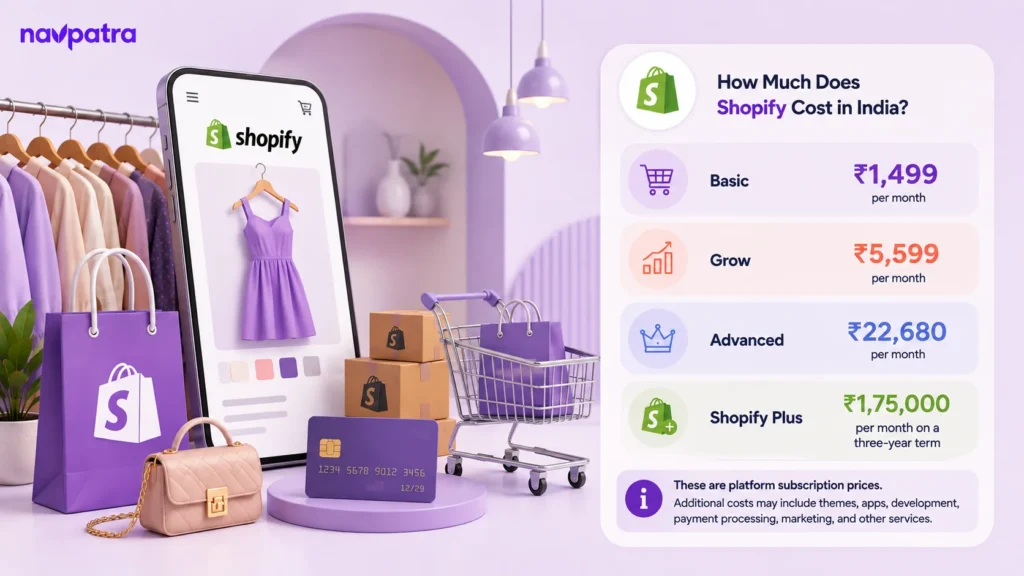
Shopify’s current India pricing lists the following annual-billing prices:
- Basic: ₹1,499 per month
- Grow: ₹5,599 per month
- Advanced: ₹22,680 per month
- Shopify Plus: Starting at ₹1,75,000 per month on a three-year term
These are platform subscription prices. A brand may also need to budget for themes, apps, development, payment processing, marketing, and other ecommerce services.
Therefore, don’t compare Shopify and WooCommerce only on their advertised entry price. Compare the total cost of running the store.
Is WooCommerce Better Than Shopify for Fashion Brands?
WooCommerce can be better when customization and technical control are more important than simplicity. It runs on WordPress and provides extensive control over the ecommerce website. Its marketplace includes hundreds of free and paid extensions for adding functionality as the store grows.
It can be particularly useful for fashion businesses with unusual requirements.
Imagine a designer clothing brand that sells made-to-order outfits. Customers might need to select fabric, enter measurements, choose custom finishes, and request alterations.
That is a much more complicated product experience than simply choosing a size and colour.
WooCommerce can provide a strong foundation for such custom workflows because developers have greater control over the WordPress environment. However, that flexibility comes with responsibility. A WooCommerce business may need to manage:
- Hosting and server performance
- WordPress and plugin updates
- Security
- Backups
- Plugin compatibility
- Custom development
- Database optimization
Shopify vs WooCommerce for Fashion Product Variations
Product variations are one of the most important considerations for fashion ecommerce.
A single T-shirt might have five sizes and six colours. That creates 30 possible combinations. Each combination can have its own inventory level, SKU, image, or pricing information.
Both Shopify and WooCommerce can manage these variations.
- Shopify currently supports up to three product options and up to 2,048 variants per product. This is sufficient for many standard fashion catalogues.
- WooCommerce variable products allow merchants to control attributes such as size and colour and manage pricing, stock, images, and other information for individual variations.
- WooCommerce also provides extensions for more advanced variation experiences, including additional images for different shirt colours or shoe-size options.
- For a typical clothing brand, Shopify’s native functionality will usually be enough.
- For a brand with unusually complex product configurations, WooCommerce gives developers more room to customize the experience.
Which Is Better for Fashion Website Design?
Both Shopify and WooCommerce can create high-quality fashion websites. The difference is how much control you want over the implementation.
A fashion website needs to do more than look attractive. Customers should be able to answer important questions quickly:
What is the product? What material is it made from? Which sizes are available? What colours can I choose? How does it fit? When will it arrive? Can I return it?
This information should be easy to find on mobile and desktop.
Shopify provides ecommerce-focused themes and a large ecosystem of apps. That makes it practical for brands that want to launch a polished storefront without building every component from scratch.
WooCommerce gives developers more freedom because the store sits within WordPress. This can be particularly valuable when the website needs a highly customized design or a complex content structure.
For most startups, Shopify offers enough design flexibility.
For businesses with a dedicated development team, WooCommerce can offer greater control.
Which Is Better for Fashion SEO?
WooCommerce has an advantage in technical flexibility, but Shopify can also support a strong fashion SEO strategy. WooCommerce benefits from WordPress’s content management capabilities. It can be useful for fashion brands that plan to build a large organic content ecosystem. For example, a clothing brand could create content around:
- Fashion trends
- Styling guides
- Size and fit guides
- Fabric comparisons
- Seasonal collections
- Outfit ideas
- Product comparisons
- Fashion buying guides
The content can then support relevant category and product pages through internal links. However, choosing WooCommerce does not automatically make a website better for SEO.
A Shopify store can rank well when its technical implementation, content, internal linking, product information, structured data, and performance are strong. The same applies to WooCommerce.
For AEO and AI search, product information is particularly important. A product page should provide clear answers about the product, material, fit, available sizes, colours, use cases, price, availability, shipping, and returns. That gives search engines and AI systems more useful information to interpret and potentially cite.
Insights: A well-designed website can significantly increase engagement, with users spending up to 84% more time on your site, while also driving up to a 132% year-over-year growth in online revenue.
Which Is Better for Payments and COD in India?
For Indian fashion brands, payment functionality should be checked before choosing a platform.
Customers may expect UPI, cards, net banking, wallets, and cash on delivery. The store may also require integrations for shipping, returns, refunds, and order management.
WooCommerce has a broad extension ecosystem for payment and commerce integrations. Shopify also provides payment and commerce integrations through its ecosystem.
However, don’t assume that every payment gateway works identically on both platforms. Before development, verify your preferred payment provider’s:
- Transaction fees
- Settlement process
- COD support
- Refund workflow
- Plugin or app requirements
- Supported Shopify or WooCommerce plans
Which Is Easier to Scale?
Shopify is generally easier to scale operationally, while WooCommerce gives you more control over the infrastructure used to scale. This distinction matters during major campaigns. Suppose a fashion influencer features your product and thousands of visitors arrive within a few minutes.
With Shopify, the platform manages the underlying ecommerce infrastructure.
With WooCommerce, your hosting environment, caching, CDN, database configuration, and website code all play a larger role in determining performance.
That does not mean WooCommerce cannot handle large fashion stores. It can.
It means scaling WooCommerce successfully usually requires stronger technical management.
For a growing fashion brand without an internal technical team, Shopify’s managed approach can therefore be a significant advantage.
Shopify vs WooCommerce: Which Should a Fashion Brand Choose?
The answer depends on your business model.
Choose Shopify when you want:
- Faster implementation
- Lower technical maintenance
- Managed infrastructure
- Strong D2C capabilities
- Easy day-to-day store management
- A large ecosystem of ecommerce integrations
Choose WooCommerce when you need:
- Deep customization
- WordPress integration
- Greater control over the website
- Custom ecommerce workflows
- Extensive content integration
- More control over hosting and development