



The best ecommerce platform for fashion brands is not simply about finding platforms to sell products online. Your platform affects your storefront, product discovery, checkout, payments, inventory, SEO, shipping, and long-term scalability.
For Indian fashion brands, the decision is even more important. Customers expect a smooth mobile experience, multiple payment options, accurate size and colour information, easy returns, and a fast checkout.
So, which platform should you choose?
Shopify is the best overall ecommerce platform for most fashion brands in India. It combines ease of use, fashion-friendly storefronts, ecommerce features, multichannel selling, and scalability.
However, WooCommerce can be a better choice for brands that need deep customization. Wix works well for smaller businesses, BigCommerce suits larger catalogues, and Magento or Adobe Commerce fits enterprise businesses.
Let’s compare them.
- Shopify is the best overall choice for most Indian fashion brands, offering simplicity, scalability, multichannel selling, and strong ecommerce functionality.
- WooCommerce suits brands needing extensive customization, flexibility, and technical control, but requires greater responsibility for maintenance and performance.
- BigCommerce is suitable for established fashion brands managing large catalogues, multiple channels, complex operations, and advanced integration requirements.
- Fashion ecommerce platforms must support product variants, high-quality media, inventory, reviews, mobile shopping, payments, shipping, returns, SEO, and social commerce.
What Is the Best Ecommerce Platform for Fashion Brands in India?
The five platforms worth considering are:
- Shopify: Best overall for D2C fashion brands
- WooCommerce: Best for flexibility and customization
- Wix Ecommerce: Best for beginners and small fashion businesses
- BigCommerce: Best for larger fashion brands and scaling
- Magento / Adobe Commerce: Best for enterprise fashion businesses
There is no single platform that is perfect for every fashion brand. Your choice should depend on your catalogue size, technical requirements, budget, growth plans, and customization needs.
| Platform | Best For | Customization | Scalability | Ease of Use |
|---|---|---|---|---|
| Shopify | D2C and growing fashion brands | High | Excellent | Excellent |
| WooCommerce | Custom stores | Excellent | Excellent | Moderate |
| Wix Ecommerce | Small brands and beginners | High | Moderate | Excellent |
| BigCommerce | Larger catalogues | High | Excellent | High |
| Magento | Enterprise brands | Excellent | Excellent | Low |
Why Is Choosing the Right Ecommerce Platform Important for Fashion Brands?
Fashion ecommerce has different requirements from many other online businesses. A fashion store may have hundreds of products with different sizes, colours, materials, fits, and styles. It also needs strong product photography, filters, reviews, size guides, inventory management, and promotional tools. The platform should therefore help you manage:
- Product variants such as size and colour
- High-resolution product images and videos
- Product categories and collections
- Inventory across different channels
- Online payments and COD
- Shipping and returns
- Discounts and promotional campaigns
- Customer reviews
- Mobile shopping
- SEO and content marketing
- Social commerce
- Analytics and customer data
A strong ecommerce platform reduces friction across the buying journey. It also gives your team the tools to manage products and orders efficiently.
Is Shopify the Best Ecommerce Platform for Fashion Brands?
Yes, Shopify is the best choice for most fashion brands in India.
Shopify provides an ecommerce ecosystem covering online stores, inventory, marketing, shipping, analytics, POS, and multichannel selling. Its fashion commerce resources also highlight product variants, responsive storefronts, product reviews, inventory management, and social selling.
Why Is Shopify Good for Fashion Brands?
Fashion brands need visually appealing storefronts. Shopify supports customizable ecommerce themes, product media, product recommendations, search, filtering, and responsive shopping experiences.
It also supports selling across multiple channels. It is useful for fashion brands that combine their website with social commerce, marketplaces, or physical retail. Other advantages include:
- Easy product and inventory management
- Mobile-friendly storefronts
- SEO and blogging functionality
- Large app ecosystem
- Multichannel selling
- POS functionality
- Marketing and analytics tools
- Managed hosting and infrastructure
- International selling capabilities
Shopify’s ecosystem also lets brands extend their stores with apps for marketing, shipping, returns, inventory, and other functions.
Insights: About 94% of the time, users form their opinion about a website based on its design, and an average user takes only 0.05 seconds to decide how they feel about a website after landing on it.
How Much Does Shopify Cost in India?
Shopify’s current India pricing lists the Basic plan at ₹1,499 per month when billed annually. The Grow plan starts at ₹5,599 per month, while Advanced starts at ₹22,680 per month when billed annually.
Shopify Plus starts at ₹1,75,000 per month on a three-year term. However, the subscription is only part of the total cost. A fashion brand may also spend money on:
- Premium themes
- Apps
- Payment processing
- Store development
- Custom features
- Marketing
- Maintenance
Therefore, compare the total cost of ownership, not just the monthly platform fee.
Is WooCommerce Better Than Shopify for Fashion Brands?
WooCommerce can be better than Shopify when customization and control are the main priorities.
WooCommerce is an open-source ecommerce platform built on WordPress. It gives businesses substantial control over their store and provides extensive customization through themes, extensions, and integrations.
Why Choose WooCommerce for Fashion Ecommerce?
Fashion brands often need unique product pages. For example, a clothing brand may need separate images for different colours, custom size selectors, personalized products, special checkout rules, or advanced product filtering.
WooCommerce supports extensive product variations. Its ecosystem also includes hundreds of free and paid extensions for expanding store functionality.
WooCommerce also supports major payment methods, including cash on delivery, and lists 140 region-specific payment gateways within its ecosystem. The trade-off is technical responsibility. You may need developers to manage:
- Hosting
- Security
- Updates
- Backups
- Performance
- Plugin compatibility
- Custom development
So, WooCommerce offers greater control, but it can require more technical management than Shopify.
Shopify vs WooCommerce for Fashion Brands
The Shopify vs WooCommerce fashion debate ultimately comes down to simplicity versus control.
| Factor | Shopify | WooCommerce |
|---|---|---|
| Setup | Easier | More technical |
| Customization | High | Very high |
| Hosting | Managed | Usually self-managed |
| Product variations | Strong | Very flexible |
| SEO | Strong | Highly customizable |
| Payment options | Extensive | Extensive |
| Maintenance | Lower | Higher |
| WordPress integration | No | Native |
| Technical control | Moderate | Excellent |
| Best for | Fast-growing D2C brands | Custom stores |
Choose Shopify if you want to launch quickly and focus more on selling than technical maintenance.
Choose WooCommerce if you need extensive control and have the technical resources to manage the website.
Is Wix Ecommerce Good for Fashion Brands?
Wix Ecommerce is a good option for small fashion businesses and beginners. Its biggest advantage is its visual website-building experience. Wix currently offers more than 500 ecommerce templates, mobile-optimized storefronts, product variants, inventory management, SEO tools, multichannel selling, and payment integrations.
Wix supports product variations such as colours, materials, and sizes. It also lets merchants manage pricing, stock, SKUs, and other information for individual variants. It makes Wix suitable for:
- Boutique fashion stores
- Small clothing businesses
- Independent designers
- New fashion brands
- Businesses with relatively simple catalogues
Wix also supports product catalogues of up to 50,000 products and provides tools for inventory, shipping, reviews, SEO, and multichannel selling.
However, brands with increasingly complex ecommerce operations may eventually benefit from a more specialized platform.
Insights: A well-designed website can significantly increase engagement, with users spending up to 84% more time on your site, while also driving up to a 132% year-over-year growth in online revenue.
Is BigCommerce Good for Fashion Brands?
BigCommerce is a strong option for established fashion brands with larger catalogues and complex ecommerce requirements.
BigCommerce provides core ecommerce capabilities such as product catalogues, checkout, payment processing, inventory management, shipping, returns, customer groups, and analytics.
Its current documentation also highlights support for complex catalogues and faceted search, which can be valuable for fashion stores with large product ranges. BigCommerce can therefore suit fashion companies with:
- Large product catalogues
- Multiple sales channels
- Complex operations
- Larger teams
- B2B and wholesale requirements
- Advanced integration needs
For a small fashion startup, however, the platform may provide more functionality than it initially needs.
Is Magento Good for Enterprise Fashion Brands?
Magento, through Adobe Commerce, is best suited to enterprise fashion businesses with complex requirements.
Adobe Commerce is designed for businesses that require highly customized ecommerce experiences, complex integrations, advanced catalogues, and scalable commerce infrastructure. It makes Magento suitable for brands that need:
- Complex product structures
- Advanced integrations
- Multiple business models
- Customized customer experiences
- Enterprise-level operations
- Greater control over commerce workflows
The downside is complexity. Enterprise implementations generally require experienced developers, technical teams, and a larger implementation budget. That makes Magento or Adobe Commerce less suitable for a small fashion startup.
Which Ecommerce Platform Is Best for Fashion SEO?
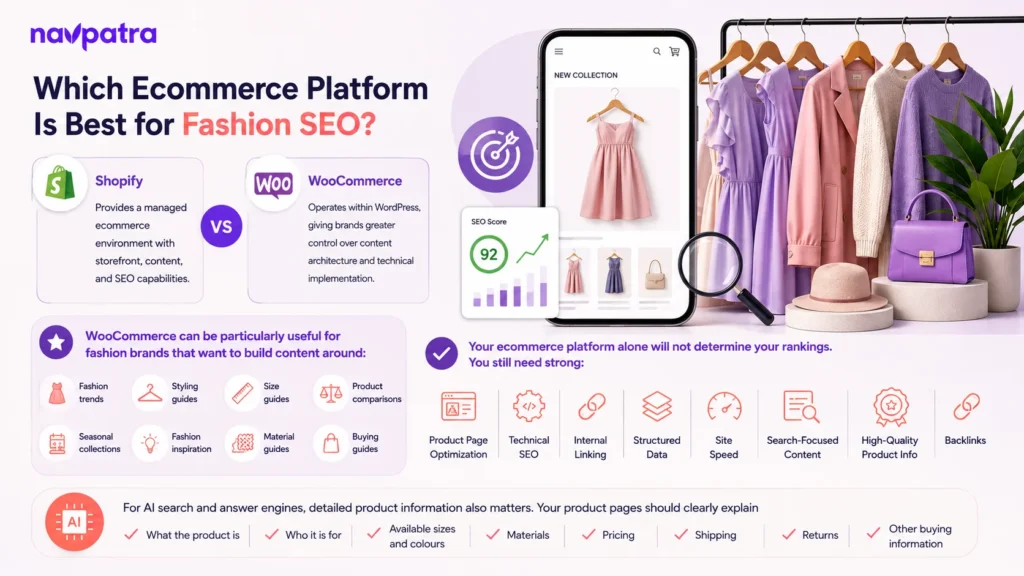
Shopify and WooCommerce are both strong choices for fashion SEO, but they offer different levels of technical control.
Shopify provides a managed ecommerce environment with storefront, content, and SEO capabilities. WooCommerce operates within WordPress, giving brands greater control over their content architecture and technical implementation. It can be particularly useful for fashion brands that want to build content around:
- Fashion trends
- Styling guides
- Size guides
- Product comparisons
- Seasonal collections
- Fashion inspiration
- Material guides
- Buying guides
However, your ecommerce platform alone will not determine your rankings. You still need strong:
- Product page optimization
- Technical SEO
- Internal linking
- Structured data
- Site speed
- Search-focused content
- High-quality product information
- Backlinks
For AI search and answer engines, detailed product information also matters. Your product pages should clearly explain what the product is, who it is for, available sizes and colours, materials, pricing, shipping, returns, and other buying information.
Which Platform Is Best for Indian Fashion Ecommerce?
For India, your platform should support the payment, fulfilment, and customer experience your audience expects. Some of the important considerations include:
- UPI and online payments
- Cash on delivery
- Shipping integrations
- Return management
- Mobile-first shopping
- WhatsApp and social selling
- GST-related workflows
- Inventory synchronization
- Marketplace integration
WooCommerce supports cash on delivery and offers a large ecosystem of regional payment gateways.
Shopify also provides payment, inventory, shipping, POS, and multichannel commerce capabilities through its ecosystem.
Wix offers more than 50 payment gateways globally, although payment availability varies by region.
Before selecting a platform, Indian brands should verify the specific payment gateways, transaction fees, shipping integrations, tax requirements, and features available for their business and plan.
Final Verdict: What Is the Best Ecommerce Platform for Fashion Brands?
Shopify is the best ecommerce platform for most fashion brands in India.
It offers a strong balance between ease of use, storefront design, ecommerce functionality, scalability, multichannel selling, inventory management, and technical simplicity. Its current India plans also cover businesses from smaller merchants to more complex and high-volume operations.
However, WooCommerce is the better choice when customization and technical control are more important than simplicity.
Wix is suitable for smaller fashion businesses. BigCommerce is stronger for larger and more complex catalogues. Magento or Adobe Commerce is better suited to enterprise-level commerce.
The right choice is therefore not about selecting the platform with the most features. It is about selecting the platform that matches your business model, catalogue, budget, technical capabilities, and growth strategy.
For most Indian fashion startups and D2C brands, that balance makes Shopify the strongest starting point for building and scaling an online fashion store.